
8 Week Local SEO Plan for Small Business That Wins the Map Pack
Claim and fully optimize your Google Business Profile, fix your business name, address, and phone number everywhere they appear online, and start a steady flow of customer reviews. Those three moves drive the largest, fastest gains in local search rankings. Expect visible movement in your Google Business Profile within a few weeks, with reviews and citations compounding over several months as Google builds more confidence in your business.
TL;DR:
- Claim, verify, and complete every field of your Google Business Profile within the first few weeks to improve your visibility and ranking speed.
- Optimize your website with location-specific content, structured data, and fast mobile performance to reinforce signals from your GBP and rank in organic local results.
- Ensure your business name, address, and phone number are consistent across all online directories and re-audit these citations every six to twelve months.
- Gather honest, recent reviews steadily, respond promptly to all feedback, and use keyword-rich content in reviews to boost relevance signals.
- Focus on building local backlinks through community sponsorships and resources, as these promote prominence and can significantly impact your local search rank.
Table of Contents
- What Is Local SEO for Small Business, and Why Does the Local Pack Matter?
- How Do You Claim and Optimize Your Google Business Profile?
- How Do You Optimize Your Website for Local Search Visibility?
- How Do You Fix NAP Consistency and Local Citations?
- How Do You Get More Reviews and Handle Negative Feedback?
- How Do You Build Local Links and Community Prominence?
- How Do You Track Local SEO Progress and Set Realistic Expectations?
- Your 8-Week Local SEO Checklist: A Week-by-Week Action Plan
- Dot Xero’s Take: What Actually Moves the Needle for Local Clients
- How Dot Xero Can Help You Execute This Checklist
- Sources
- FAQ
What Is Local SEO for Small Business, and Why Does the Local Pack Matter?
Local SEO is the practice of optimizing your online presence so people searching nearby find your business first, whether they type a query into Google or ask a voice assistant while driving. It differs from general SEO in one key way: instead of competing for national rankings, you’re competing for the three or four spots that show up in the Local Pack, that map and business listing block that appears above regular search results for queries like “plumber near me” or “jewelry store Las Vegas.”
Google decides who fills those spots using three pillars, according to its own documentation on how local search works:
- Relevance — how well your business profile matches what the searcher wants
- Distance — how close your location is to the searcher or the area they specified
- Prominence — how well known and well reviewed your business is, both online and off
The payoff for ranking well here is real money. A searcher who clicks a business in the Local Pack is often looking to buy or visit within hours, not browse for a week. That’s why a mechanic shop or a divorce attorney showing up in those top three spots tends to see far more phone calls and walk-ins than one buried on page two of organic results, where local intent rarely gets past the fold.
How Do You Claim and Optimize Your Google Business Profile?
Your Google Business Profile (GBP) is the single highest-leverage asset in local SEO for small business. It’s free, it’s the primary data source for the Local Pack, and most owners leave half its fields blank. Here’s the order that produces results fastest.
- Claim and verify your listing. Search your business name on Google, click “Own this business?” and complete verification, usually by phone, email, or postcard. Google explicitly states that verification and up-to-date information improve your local ranking, so skipping this step caps everything else you do.
- Choose your primary category with precision. “Personal Injury Attorney” outranks “Lawyer” for injury searches almost every time. Pick the narrowest accurate category, then add two or three secondary categories that cover real services you offer.
- Fill in every field. Business description, service list or products, regular hours, and holiday hours all feed relevance signals. An incomplete profile competes at a disadvantage against a rival with every field checked.
- Add real photos regularly. Interior, exterior, team, and work-in-progress shots outperform stock images. Google’s own product updates note that photos, posts, and Q&A activity are central signals for map visibility.
- Correct your map pin. A pin dropped a block off, common in strip malls and shared buildings, quietly kills your distance score for nearby searches.
- Turn on messaging or booking if your business model supports it, and answer Q&A questions before customers even ask them.
Pro Tip: Set a recurring 15-minute Friday task to add one new photo and check for unanswered questions or messages. Profiles that show consistent weekly activity tend to outperform ones that get a big push once and then sit untouched for months.
How Do You Optimize Your Website for Local Search Visibility?
Your Google Business Profile gets you into the Local Pack. Your website is what wins the organic local results sitting just below it, and it reinforces every signal your GBP sends.
If you serve more than one city or neighborhood, build a dedicated location page for each one, but only if you can make it genuinely useful. A thin page with just a swapped city name gets ignored; a page with real driving directions, staff bios, local project photos, and neighborhood-specific testimonials earns its place.
Structured data does the heavy lifting behind the scenes. Adding LocalBusiness schema markup to your site, with fields for name, address, phone, geo-coordinates, hours, and service area, helps search engines and AI-driven answer tools understand exactly who you are and where you operate.
A few on-page basics round it out:
- Put your city or neighborhood naturally into title tags, H1 headings, and meta descriptions, paired with a clear call to action like “Schedule a free estimate.”
- Avoid stuffing the same city name into every heading on the page; one clear mention per element reads naturally and avoids looking spammy.
- Check your Core Web Vitals scores. A slow mobile site loses local customers before they ever see your offer, since most local searches happen on a phone in the moment someone needs a service.
If your current site can’t support location pages or loads slowly on mobile, that’s usually a sign the foundation needs rebuilding before content additions will help.
How Do You Fix NAP Consistency and Local Citations?
NAP stands for Name, Address, Phone number, and it needs to match, character for character, everywhere your business appears online. Google’s own guidance on business information formatting points out that small inconsistencies, like “St.” versus “Street” or a missing suite number, can fragment the signals search engines use to confirm your business is real and established.
Run a quick audit and fix conflicts in this order:
- Search your business name plus city and note every directory listing that surfaces, including old ones you forgot existed.
- Pick one canonical NAP format and write it down exactly, punctuation included, so every future listing matches.
- Fix your highest-authority listings first: Google Business Profile, Yelp, Bing Places, and Apple Maps.
- Move to secondary listings: your local chamber of commerce directory, industry-specific directories, and any local business associations.
- Re-audit every 6 to 12 months, since directories change formats and data aggregators occasionally reintroduce old, incorrect information.
Old citations from a previous address or a former phone number are common and quietly undercut everything else you’re doing.
How Do You Get More Reviews and Handle Negative Feedback?
Review quantity matters, but recency and velocity matter just as much. A business with 40 reviews spread evenly over three years signals less current activity than one with 15 reviews in the last two months. Buying reviews or offering discounts in exchange for them violates Google’s policies and risks having your profile flagged entirely, so steady, honest requests are the only sustainable approach.
- Ask in person right after a good outcome, when satisfaction is highest.
- Send a one-click review link by text or email within 24 hours of service completion, while the experience is still fresh.
- Keep the ask short: “Thanks for choosing us today. If you have 30 seconds, a Google review helps other locals find us: [link].”
- Respond promptly to every review, positive or negative, to build trust and signal active management.
- For a negative review, acknowledge the specific issue, apologize where warranted, and offer to resolve it offline rather than arguing in the comments.
Industry reporting also points to keyword content inside reviews as a relevance signal, since a review that mentions “same day water heater repair” reinforces exactly the phrase a future customer might search.
Pro Tip: Track review response time in a simple spreadsheet. Businesses that reply fast and specifically, rather than with a copy-pasted “thank you,” tend to build more trust with readers browsing the review list before they call.
How Do You Build Local Links and Community Prominence?
Prominence, the third ranking pillar, rewards businesses that other credible local sources talk about. A single link from your local chamber of commerce or a mention in the neighborhood newspaper typically moves that needle faster than a dozen generic directory submissions, since link relevance carries more weight than link volume in local search.
Tactics that work on a small budget:
- Sponsor a local youth sports team or community event in exchange for a link from their site.
- Join your chamber of commerce and industry associations that maintain member directories with links.
- Offer a genuinely useful local resource, like a neighborhood parking guide or a seasonal maintenance checklist, that other local sites want to reference.
- Set a Google Alert for your business name to catch unlinked mentions, then email the site asking politely for a link.
Every mention that turns into a link strengthens the exact signal that separates a business ranking third from one ranking tenth.
How Do You Track Local SEO Progress and Set Realistic Expectations?
A handful of metrics tell you whether your work is paying off. Track Map Pack visibility for your top five search terms, monthly calls and direction requests from your GBP, organic ranking for local keyword phrases, review count and rating trend, and conversion actions like form fills or booking clicks.
Google Business Profile Insights and Google Search Console handle most of this for free, supplemented by a simple weekly rank check and a spreadsheet tracking new reviews.
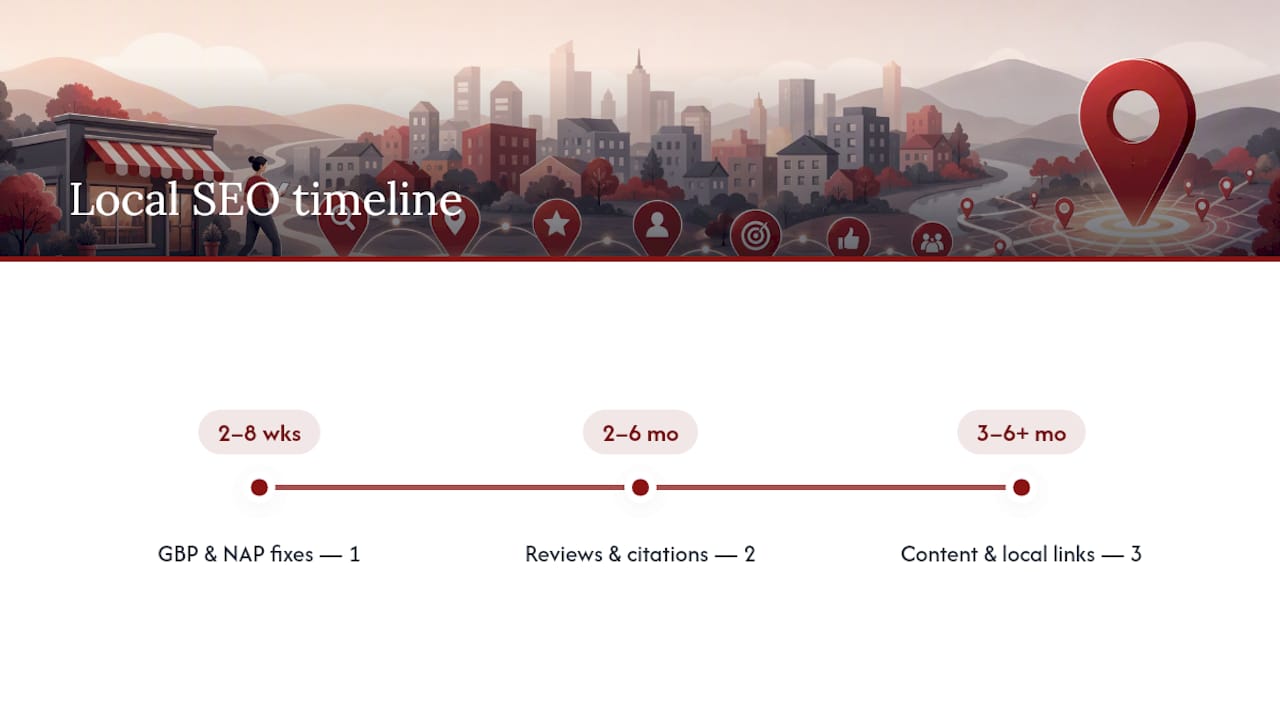
On timelines: GBP and NAP fixes tend to show movement in 2 to 8 weeks, since they’re direct signals Google reads quickly. Review and citation compounding takes 2 to 6 months as your profile builds sustained trust. Content and local link gains usually take 3 to 6 or more months, particularly in competitive markets like legal services or real estate. A prioritized checklist approach focused on GBP, citations, and reviews produces the fastest measurable wins, which is exactly why those three items come first in this guide, not last.
Your 8-Week Local SEO Checklist: A Week-by-Week Action Plan
This sequence assumes one owner or one staff member spending a few hours a week. Adjust pace if you’re delegating to a team member or an outside vendor.
- Week 1: Claim and verify your Google Business Profile. Owner task, 2 to 3 hours.
- Week 2: Complete every GBP field: categories, description, hours, services. Owner or staff.
- Week 3: Run your NAP audit and document your canonical format. Staff task, half a day.
- Week 4: Fix your top 5 directory listings (Google, Yelp, Bing, Apple Maps, chamber).
- Week 5: Launch your review request system using a templated text or email.
- Week 6: Add LocalBusiness schema to your homepage and contact page.
- Week 7: Publish or update one location page with unique local content.
- Week 8: Post your first GBP update using a template like: “We just finished [service] for a customer in [neighborhood]. Ask us about [offer] this month.”
| Week | Focus Area | Expected Signal |
|---|---|---|
| 1 to 2 | GBP claim and completion | Profile marked complete, verified status live |
| 3 to 4 | NAP and citations | Consistent listings across top 5 directories |
| 5 to 6 | Reviews and schema | New reviews arriving weekly, schema validated |
| 7 to 8 | Content and posts | Location page live, first GBP post published |
In competitive markets, expect the timeline to stretch. A downtown law firm competing against a dozen established practices should plan for the review and content phases to run closer to 4 months rather than 6 weeks.
Dot Xero’s Take: What Actually Moves the Needle for Local Clients
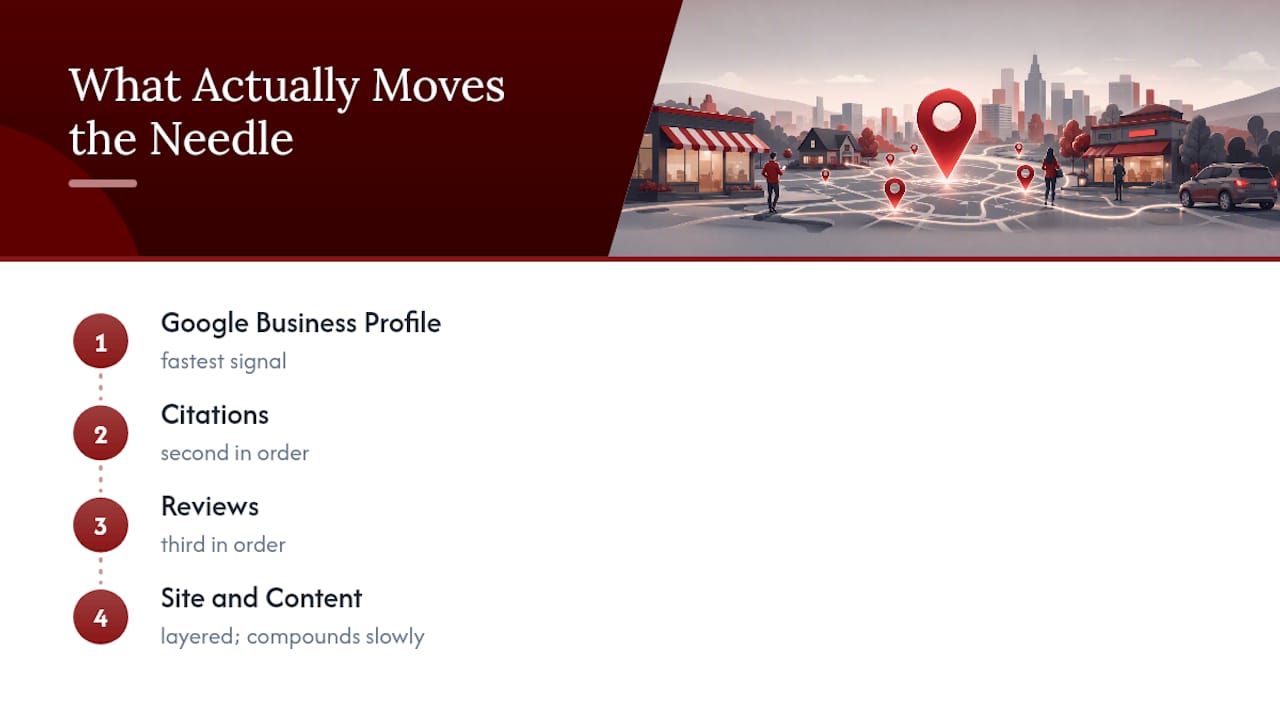
Since 2007, Dot Xero has sequenced this exact order for Las Vegas clients: Google Business Profile first, citations second, reviews third, then site and content work layered on top. That order isn’t arbitrary. It reflects which signals Google reads fastest and which take longer to compound.
The honest answer on whether to handle this yourself: if you have one location, a few hours a week, and comfort with basic web tools, the checklist above gets you real results. Multi-location businesses, or owners with zero spare time, usually see faster returns handing the technical pieces to someone who does this daily.
— Will
How Dot Xero Can Help You Execute This Checklist
Dot Xero provides a diagnostic audit built around your actual industry, whether that’s a law firm, a jewelry store, or a contracting business.
The checklist above works, but executing all of it while running daily operations is where most owners stall out around week 4 or 5. Dot Xero’s local SEO services cover Google Business Profile optimization, citation cleanup, location page builds, and structured review programs, with transparent reporting so you can see exactly what’s moving and why. If your website itself is the bottleneck, slow load times or no mobile-first design, the website development team can rebuild the foundation before adding local content on top. Request a diagnostic audit to see where your profile, citations, and site currently stand, and get a realistic timeline for your specific market and competition level.
Sources
- Tips to improve your local ranking on Google — Google Business Profile Help
- Google Maps new features for business profiles — Google Blog
- Local SEO guide — Backlinko
FAQ
How Long Does Local SEO Take to Show Results?
Google Business Profile and NAP fixes typically show measurable movement in 2 to 8 weeks, while review and citation compounding takes 2 to 6 months, and content or link gains often need 3 to 6 months or more in competitive markets.
Do I Need a Website to Rank in the Local Pack?
No, the Local Pack pulls primarily from your Google Business Profile, but a fast, mobile-optimized site with LocalBusiness schema strengthens organic rankings that appear alongside it.
Should I Respond to Every Google Review?
Yes, responding promptly to both positive and negative reviews builds trust with future customers browsing your listing and signals active management to Google.
Can I Pay to Rank Higher in Google Maps?
No, Google’s own local search documentation confirms there is no mechanism to pay for improved local rankings; ranking depends on relevance, distance, and prominence signals.
What’s the Single Best First Step for Local SEO for Small Business?
Claim and fully verify your Google Business Profile, since it’s free, it directly feeds the Local Pack, and most competitors leave their profiles incomplete.