
SMBs: Audit First and Build Local Citations Starting With 10–20 Sites
Local citations are online mentions of your business name, address, and phone number, or NAP, published across directories, apps, and industry sites. The first move isn’t building new listings. It’s auditing what already exists, fixing NAP inconsistencies, and locking down your Tier 1 profiles before you submit anywhere else. Start with 10 to 20 core sites, expanding toward 50 in competitive markets once your foundation is clean.
TL;DR:
- Auditing existing citations and fixing NAP inconsistencies are crucial to establish a reliable foundation before submitting new listings.
- Focus on securing and optimizing Tier 1 profiles on primary platforms like Google, Apple, Bing, Facebook, and Yelp first, as errors here significantly impact search visibility.
- Automated tools can accelerate bulk submissions but manual effort remains necessary for niche directories and hyperlocal sites that influence rankings more directly.
- Aggregator submissions take two to six months to propagate, so consistent NAP data and proper indexation verification are essential for long-term results.
- Avoid chasing niche directories prematurely; instead, ensure your core citations are accurate to prevent conflicts and maximize local SEO and AI-driven search signals.
Table of Contents
- What Counts as a Local SEO Citation?
- Why Citations Still Matter for Local Search and AI Results
- Auditing Existing Citations and Fixing NAP Inconsistencies
- Building Citations: A Step-by-Step Workflow
- Tracking Indexation and Measuring What Citations Actually Do
- What Actually Goes Wrong With Citation Work
- Get Your Local Citations Handled Without the Guesswork
- Sources
- FAQ
What Counts as a Local SEO Citation?
A citation comes in two forms. A structured citation lives on a directory page with defined fields: business name, address, phone, website, hours, and category. An unstructured citation is a mention buried in a blog post, news article, or social caption where your NAP appears in running text rather than a form field.
Both types feed the same signal to search engines: consistent proof that your business exists at a specific location. That’s the core distinction most business owners miss when they lump citations in with backlinks.
Citations and links overlap sometimes, but they’re not the same discipline. Citation work centers on NAP accuracy, not link acquisition, even though a citation might carry a clickable link back to your site as a byproduct. Confusing the two leads business owners to chase high-authority backlink sites while ignoring the unglamorous directories that actually move local rankings.
Fields that typically matter across platforms:
- Business name (exact legal or trade name, formatted the same everywhere)
- Physical address, including suite or unit number
- Phone number in one consistent format
- Website URL, ideally the canonical version
- Hours of operation and business category
Why Citations Still Matter for Local Search and AI Results
Citations help Google verify that your Google Business Profile is legitimate, which affects whether you show up in the local pack at all. Inconsistent data across the web makes Google less confident in your listing, and that hesitation shows up as lower map rankings.
There’s a newer wrinkle worth flagging. Practitioner surveys increasingly rank citations as important for AI-driven search visibility, since tools that generate AI answers about local businesses tend to pull from the same aggregated, structured data that citations feed. Clean NAP data isn’t just a Google Maps play anymore. It’s raw material for whatever AI search interface a customer happens to be using.
The signal behind the signal: Citations rarely move rankings by themselves. What they do is unlock indirect benefits, more review opportunities, faster indexation of new pages, and stronger trust signals that compound with everything else you’re doing in search.
Citations pay off fastest for new businesses with no digital footprint yet, for niche verticals with thin competition, and for sites in industries where a handful of authoritative directories dominate search results. A brand-new law firm with zero citations will see more movement from building 20 solid listings than an established retailer who already has hundreds.
Auditing Existing Citations and Fixing NAP Inconsistencies
Before adding a single new listing, find out what’s already out there. Search operators like "business name" "phone number" or "business name" "old address" surface citations you forgot existed, including ones tied to a previous location or a former phone number.
Here’s the audit sequence that actually works:
- Search and catalog. Run manual searches plus a citation-finder tool, and log every listing you find in a tracking spreadsheet with columns for site name, URL, current NAP data, and status.
- Normalize your NAP format. Decide once whether you use “St.” or “Street,” how suite numbers appear, and which phone format (dashes, dots, or parentheses) you’ll use everywhere. Small inconsistencies like these can quietly undercut your ranking signals, so pick a standard and apply it identically across every platform.
- Merge or kill duplicates. Ghost listings from a previous owner, an old address, or a rebrand need to be claimed and merged, or flagged for removal through the platform’s duplicate-reporting process.
- Record logins and update history. Every login, submission date, and confirmation email goes in the same tracking sheet. Future edits, and future agencies, will need this.
Pro Tip: Set your canonical website URL once, before you touch any directory. If your site uses “https://www.yourbusiness.com” in one listing and “https://yourbusiness.com/home” in another, that’s a NAP inconsistency too, even though most people never think of a URL that way.
Building Citations: A Step-by-Step Workflow
Work in the same order every time: Tier 1 profiles first, then aggregators, then niche directories, then social and review profiles. Skipping ahead to niche sites while your Google Business Profile still has the wrong suite number just multiplies the error.
For each submission, fill in every available field rather than the bare minimum. A description field left blank is a missed chance to reinforce category relevance. Write a two to three sentence description that states what the business does, who it serves, and where, using the same phrasing across every directory so the semantic signal stays consistent.
A tight submission checklist looks like this:
- Business name exactly as it appears on your legal filings and website
- Full address with suite number formatted the way you standardized it
- One phone number, same format everywhere
- Canonical website URL, no tracking parameters
- Category selected from the platform’s own list, not a close approximation
- Hours of operation kept current, especially around holidays
Listing-management tools speed up discovery and submission considerably, and they’re worth using once your NAP data is already clean. But manual submission is still often required for niche association directories and hyperlocal sites that tools don’t cover. Treat automation as a multiplier for volume, not a replacement for judgment on where your niche citations actually need to live.
Pro Tip: If your business has a dedicated inbox for vendor communications, use it for every citation login. A shared marketing email, rather than one employee’s personal address, keeps reporting and account access intact when staff turns over.
Tracking Indexation and Measuring What Citations Actually Do
A citation that isn’t indexed isn’t doing anything. Check indexation with a site: search for the specific directory page, or by watching for the listing to appear in your tracking sheet’s “confirmed live” column after a follow-up visit two to four weeks post-submission.
KPIs worth watching monthly:
- Local pack placement for your primary keywords
- Branded search appearance and how your NAP shows in the knowledge panel
- Referral traffic from directory listings in your analytics
- Overall NAP consistency score across your tracked citations
Aggregator-fed listings take longer to show results than direct submissions. Propagation through Data Axle, Neustar Localeze, or Foursquare typically runs two to six months before smaller downstream directories pick up the corrected data. Once your citation base is solid and indexed, shift your ongoing effort toward review generation and Google Business Profile optimization, since that’s where incremental gains tend to show up after the citation foundation is set.
What Actually Goes Wrong With Citation Work
The businesses that struggle with citations almost never fail because they picked the wrong directories. They fail because nobody kept a single source of truth. Someone builds 30 listings in a spreadsheet, the business moves suites two years later, and the website gets updated while the directories don’t. Now there are three versions of the address floating around the internet, and nobody remembers which logins belong to which platform.

The other recurring failure: skipping Tier 1 to chase niche directories because they feel more targeted. A perfectly optimized Avvo profile means little if Google Business Profile still lists the wrong phone number.
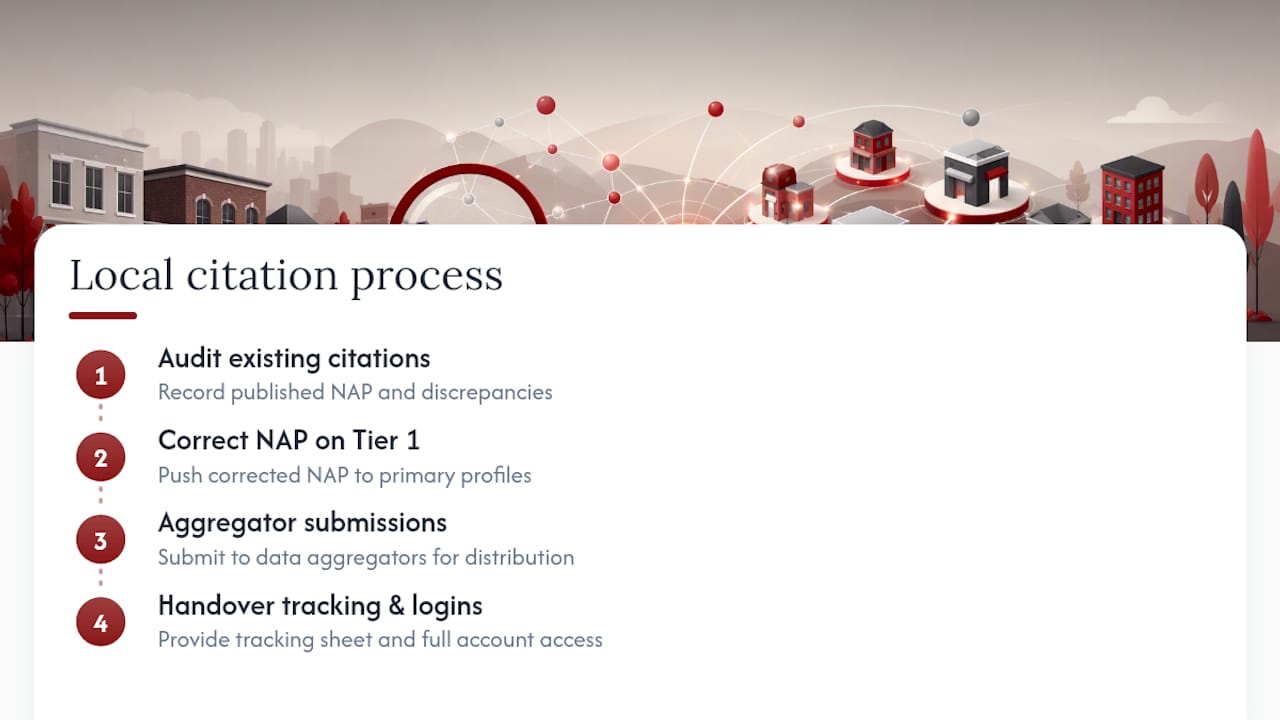
Dot Xero’s approach starts with the audit, documents every fix in a shared tracking sheet, works through aggregator submissions in sequence, and reports indexation status rather than just submission counts, as recommended in accounting for marketing agencies: streamline, comply, grow. When evaluating any vendor for this work, ask specifically what you’ll receive: a documented list of deliverables, proof of indexation rather than just a claim of submission, and full login access handed over at the end, not held hostage as leverage for renewal.
— Will
Get Your Local Citations Handled Without the Guesswork
Local citation cleanup should be a documented process, not a black box: a full audit of what’s already published, corrected NAP data pushed across your Tier 1 profiles, aggregator submissions to data aggregators, and a tracking sheet handed over with every login intact.

If you’re comparing proposals, ask any vendor for the same three things: a written list of what gets submitted, indexation confirmation rather than a submission receipt, and full access to every account created on your behalf. Those three items separate a real citation service from a recurring bill with nothing to show for it.
Citation cleanup works best alongside a site that can actually hold the canonical NAP data you’re standardizing everywhere else, which is where website development built for local businesses in mind comes in. If your citation work uncovers bigger local SEO gaps, that’s also the point to talk through a full SEO strategy rather than patching one issue at a time.
Reach out to a qualified agency to request a citation audit proposal and see exactly what a documented, handover-ready process looks like before you commit.
Sources
Not every directory deserves the same attention. Working through tiers in order keeps you from wasting hours on low-value sites before the ones that actually matter are locked in.
Tier 1: Claim these first. Google Business Profile, Apple Business Connect, Bing Places, Facebook, and Yelp function as primary verification sources. Search engines and map apps pull directly from these platforms, so errors here ripple everywhere else.
Tier 2: Data aggregators. Data Axle (formerly Infogroup), Neustar Localeze, and Foursquare don’t get much consumer traffic directly, but they feed hundreds of smaller directories automatically. A single correct submission to an aggregator can propagate to dozens of downstream sites over the following months, which is exactly why fixing errors before submitting matters so much.
Tier 3: Niche and general directories. This tier splits two ways: broad sites like Yellow Pages or Chamber of Commerce listings, and industry-specific platforms that carry outsized weight in their niche. Healthgrades for medical practices, Avvo for attorneys, and TripAdvisor or OpenTable for restaurants often move the needle more than several generic directories combined, because they signal topical relevance rather than just existence.
- What Are Local Citations? Learn Local SEO – Moz
- How to Build Local Citations & Boost Your Visibility Online | WordStream
- What is local SEO citation – Uberall
FAQ
How Many Local Citations Does a Small Business Need?
Start with the 10 to 20 most important sites for your industry, then expand toward roughly 50 if you compete in a crowded market.
Are Local Citations the Same as Backlinks?
No. Citation work focuses on accurate, consistent NAP data rather than link acquisition, even though some citations happen to include a clickable link.
How Long Does It Take for Citations to Show Results?
Direct Tier 1 submissions can index within weeks, but aggregator-fed listings typically take two to six months to propagate to downstream directories.
What Should I Fix Before Building New Citations?
Audit existing listings first and correct any inconsistent NAP data, since small discrepancies like abbreviations or old suite numbers can undercut the ranking signal you’re trying to build.
Should I Use a Tool or Submit Citations Manually?
Listing-management tools speed up bulk submission and monitoring, but manual work is still often necessary for niche or association-specific directories that automated platforms don’t cover.