
Build a Local Business Email List in 90 Days: Comply, Track, Segment
A local business email list is a house list of subscribers who gave you explicit permission to email them, not a purchased or scraped database. The fastest way to start one is to add a visible signup form on your website and a QR code or tablet at checkout, tied to a specific incentive. Before you send anything, make sure every message includes accurate sender information, your postal address, and a working opt-out link, since CAN-SPAM applies to businesses emailing even their own existing customers.
TL;DR:
- Focus on two or three strong acquisition channels, like website forms and in-store capture, for at least 90 days before expanding efforts.
- Ensure every email includes accurate sender info, a clear opt-out link, and processes opt-outs within 10 business days to stay compliant with CAN-SPAM.
- Use consistent UTM tags in all email links to track conversions like bookings and sales accurately through Google Analytics.
- Prioritize in-person signup methods, such as QR codes and staff prompts, as they convert better and are nearly free compared to passive online forms.
- Keep segmentation simple with just a few key groups, such as location or engagement level, to optimize messaging without unnecessary complexity.
Table of Contents
- Where Should You Focus Your Sign-Up Efforts First?
- What Does CAN-SPAM Actually Require From You?
- How Should You Segment a Small Local List?
- How Do You Track What Your Emails Actually Drive?
- When Does It Make Sense to Bring in Dot Xero?
- The Part Everyone Skips: Compliance and Measurement Aren’t Optional Extras
- Ready for Help Running Your Email Program?
- Where to Check Compliance and Tracking Details Yourself
- Sources
- FAQ
Where Should You Focus Your Sign-Up Efforts First?
Most local businesses waste months guessing which acquisition channel matters, when three or four channels do almost all the work. Pick two or three from the list below and commit to them for 90 days before adding more.
Your website is the anchor. Place a signup form above the fold on your homepage and again near the bottom of your blog or service pages, and keep the value proposition to one sentence: “Get 10% off your next visit” beats “Join our newsletter” every time. Embedding forms across your highest-traffic pages catches visitors who are already interested but not ready to buy. If your site needs a rebuild to support this, that’s a job custom website development handles well.
In-person capture converts better than almost anything digital because the customer is standing in front of you. A QR code on the receipt, a tablet at the register, or a simple line from staff (“Want 10% off today’s total for joining our list?”) can add dozens of names a week for a busy retail counter or salon.
- Website forms: concise offer, one field beyond email if possible, double opt-in for higher quality lists
- In-store QR codes and tablets: fastest at checkout, works for restaurants, salons, retail
- Social bios and Google Business Profile links: low effort, steady trickle of signups
- Referrals from current subscribers: HubSpot’s 2025 research found direct recommendations are the single most effective acquisition tactic newsletter professionals use
- Small paid tests: a $50 to $100 boosted post testing one offer, measured strictly by signups per dollar
Pro Tip: Ask happy customers directly to forward your welcome email to one friend. It sounds small, but referral-driven signups tend to have far better open rates than cold ones because trust is already built in.
Double opt-in (where a new subscriber confirms via a follow-up email) slows growth slightly but weeds out fake addresses and typos, which matters more once you start measuring deliverability.
What Does CAN-SPAM Actually Require From You?
The CAN-SPAM Act sets the floor, and it’s stricter than most local owners assume. Accurate header information, a subject line that doesn’t mislead, your real postal address, and a clear way to opt out are all required on every commercial email, including ones you send to people who already bought from you.
Here’s the operational checklist that keeps you compliant:
- Put the unsubscribe link somewhere obvious, not buried in gray six-point font at the very bottom.
- Process opt-out requests within 10 business days. Waiting longer is a violation, not just bad practice.
- Keep the opt-out mechanism functional for at least 30 days after you send a campaign.
- Never charge a fee or require personal information beyond an email address just to unsubscribe.
- Remove hard bounces after one failed attempt. Sending repeatedly to a dead address hurts your sender reputation with every major inbox provider.
One detail trips up more local businesses than any other: being a paying member, loyalty program participant, or repeat customer does not exempt anyone from these rules. The FTC has stated plainly that businesses can’t unsubscribe from CAN-SPAM compliance just because the recipient is already a customer or club member.
Purchased or scraped contact lists sit outside everything covered here. A list built without explicit opt-in isn’t really a house list, and running campaigns against it invites spam complaints and compliance risk that no local business needs.
How Should You Segment a Small Local List?
You don’t need many segments to see results. A few groups cover most local businesses:
- Location or neighborhood: useful for multi-location retailers, contractors, or anyone running geo-specific promotions
- Customer vs. prospect: someone who bought already gets different messaging than someone who only signed up
- Product or service interest: a dental practice might separate cosmetic-interested subscribers from routine-care ones
- Engagement level: opens and clicks in recent months versus subscribers who’ve gone quiet
Match each segment to a campaign type instead of blasting everyone the same message. New subscribers get a short welcome series (two to three emails introducing your business and delivering the signup incentive). Active customers get appointment reminders or loyalty offers. Prospects who haven’t converted get neighborhood promotions or limited-time discounts timed to slow business periods.
HubSpot’s newsletter research found that 90% of newsletter professionals tailor their strategy around a few prominent subscriber demographics rather than trying to personalize everything. That’s the right instinct for a small list. Pick one or two segments that clearly change your messaging, and leave the rest generic.
Pro Tip: Set a simple cadence and stick to it. Twice-monthly emails beat sporadic bursts followed by long silences, because subscribers forget who you are faster than you’d think.
How Do You Track What Your Emails Actually Drive?
Every link in every campaign should carry consistent UTM tags so you can see, inside Google Analytics, exactly which email drove a booking or a purchase. Use utm_source=email, utm_medium=newsletter or utm_medium=promo, and utm_campaign= followed by a specific name like spring_sale_2026. Google’s own guidance on manual tagging stresses keeping naming conventions identical across every send, or your reports fragment into a mess of near-duplicate campaign names.
Track outcomes, not just clicks: purchases, bookings, coupons redeemed, and how long it takes someone to convert after opening.
Five numbers tell you almost everything about list health:
- Open rate (subject line and sender reputation)
- Click-through rate (content relevance)
- Conversion rate (whether the offer actually works)
- Unsubscribe rate (a warning sign if it climbs)
- Revenue per recipient (the number that actually matters to your bottom line)
Run A/B tests on one variable at a time, subject line or send time, and only trust results once you’ve sent to a few hundred recipients per version.
When Does It Make Sense to Bring in Dot Xero?
Experience with signup funnels, lead magnets, and in-store capture for retail and service clients has identified common local owner oversights: consistent UTM tagging, honoring opt-outs on schedule, and connecting email sends to actual revenue in reporting. If you’re capturing signups but have no time to build welcome automations, segment properly, or audit compliance, that’s the gap an experienced local partner closes. Experienced local partners typically set up welcome and reactivation automation, build segmentation strategy, and run a compliance check before scaling send volume. If your list is under a few hundred names and you’re comfortable in your email platform, doing it yourself for now is the right call.
The Part Everyone Skips: Compliance and Measurement Aren’t Optional Extras
Most advice on this topic treats list building like a growth hack, more signups, better subject lines, and buries compliance and tracking as afterthoughs. That ordering is backwards. A list built without honoring opt-outs within 10 business days is a liability sitting in your inbox software, and a campaign without UTM tags is a guess dressed up as a strategy.
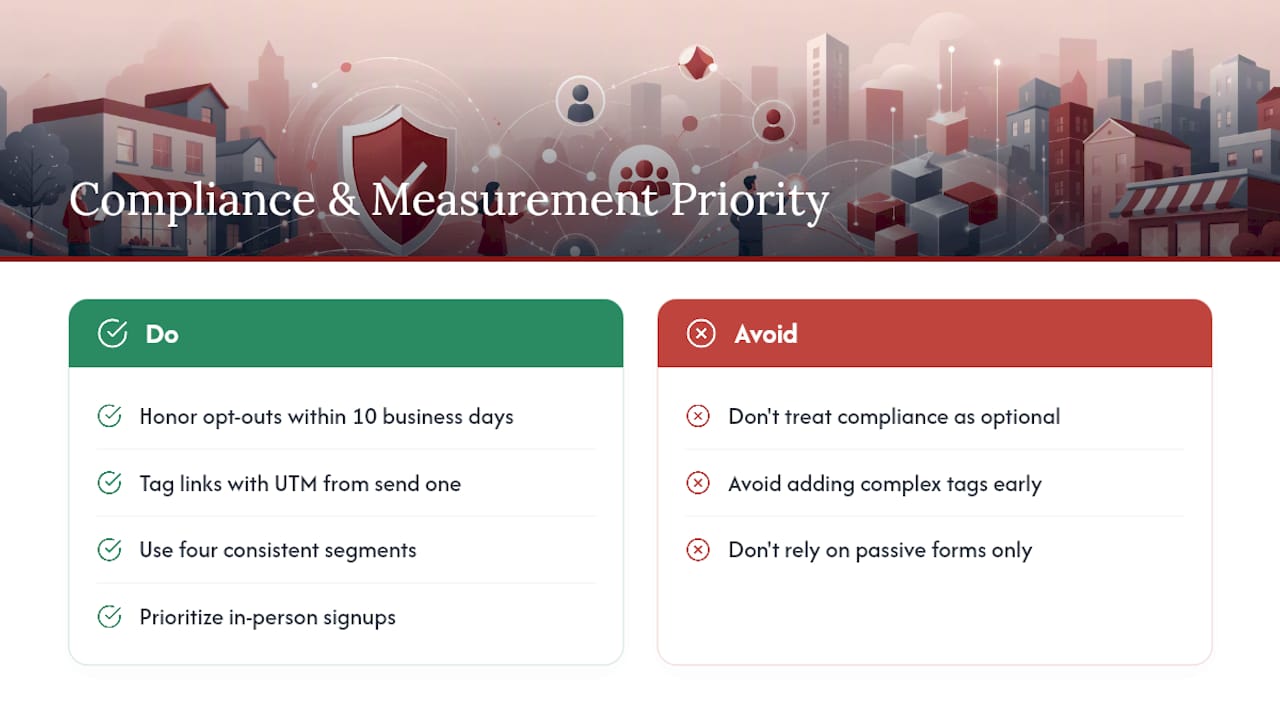
The conventional wisdom oversells segmentation complexity too. You don’t need behavioral scoring or a dozen tags to see results from a list of a few hundred names. Four basic segments, applied consistently, will outperform an elaborate scheme nobody has time to maintain.
If you take one thing from this, prioritize the signup channel that requires a real person to ask (in-store, at checkout, at the register) over passive website forms alone. It converts better and it’s nearly free. Get compliance right from send one, tag your links from send one, and only add complexity once you’ve proven the basics are working.
— Will
Ready for Help Running Your Email Program?
Choosing a knowledgeable local team can help avoid guesswork in list building and campaign setup by providing integrated forms, automation, and compliance checks tailored to various industries.
Dot Xero’s email marketing services cover strategy, automation, list growth tactics, and transparent reporting so you can see exactly what a campaign generated in bookings or sales, not just opens. Reach out for a short audit of your current signup process and email setup. You’ll get a clear read on quick wins and a straightforward proposal for campaign setup, segmentation, and reporting, no generic package, just a plan built around what your business actually needs.
Where to Check Compliance and Tracking Details Yourself
For the legal specifics, read the FTC’s CAN-SPAM compliance guide directly. For tagging, Google’s UTM and campaign tagging documentation covers every parameter. For subscriber behavior benchmarks, HubSpot’s State of Newsletters report is worth a full read.
Sources
- CAN-SPAM Act: A Compliance Guide for Business | Federal Trade Commission
- Google Analytics help: Manual tagging and campaign dimensions
FAQ
Is It Legal to Email My Existing Customers Without Asking Again?
Yes, but every commercial email still needs accurate sender information, a real postal address, and a working opt-out link under CAN-SPAM. Being an existing customer doesn’t remove those requirements.
How Fast Do I Have to Honor an Unsubscribe Request?
You must process opt-out requests within 10 business days, and the unsubscribe mechanism has to keep working for at least 30 days after a send. Missing that window is a compliance violation, not just poor customer service.
Should I Use Single or Double Opt-In for Signups?
Double opt-in adds a confirmation step that reduces fake addresses, typos, and bounce rates, which matters once your sender reputation starts affecting deliverability. Single opt-in grows your list faster but with lower average quality, so the right choice depends on how much you value list size versus list health.
What Does Dot Xero Charge for Email Marketing Setup?
Pricing depends on the scope of automation, segmentation, and reporting your business needs, so current rates are available directly through Dot Xero’s email marketing page. A short audit is the best way to get a proposal specific to your list size and goals.
How Often Should a Local Business Email Its List?
Twice a month is a reliable starting cadence for most local businesses, balanced between staying visible and avoiding fatigue that drives unsubscribes. Appointment reminders and transactional messages can go out as needed on top of that regular newsletter or promotion schedule.