
Decide in 4 Questions: Landing Page or Website for Marketers & SMBs
A website is your multi-page brand hub built for discovery, trust, and long-term SEO; a landing page is a single-page campaign tool built to convert one specific offer. If your goal is a sale, sign-up, or lead from an ad or email, use a landing page. If your goal is to be found, get trusted, and support many campaigns over time, you need a website. Most growing businesses eventually need both.
TL;DR:
- Landing pages are most effective for high-conversion campaigns targeting specific actions and should focus on message match, a single CTA, and minimal distractions.
- Websites support long-term SEO, brand trust, and discovery with multiple pages, clear navigation, and ongoing content updates, but require more time and maintenance.
- For paid traffic, directing visitors to dedicated landing pages increases conversion rates by avoiding navigation dilution and aligning message intent.
- New businesses should start with landing pages for rapid testing and validation, then expand into full websites for sustained growth and authority.
- Building effective landing pages involves defining clear goals, matching messaging, setting up tracking from the start, and testing key elements like headlines and CTAs.
Table of Contents
- Landing Page vs Website: What a Website Actually Does
- What Elements Make a Website Effective for SEO?
- What Is a Landing Page, Exactly?
- What Makes a Landing Page Convert?
- Landing Page or Website: The Core Differences
- When Should You Use a Landing Page Instead of a Website?
- Do I Need a Website If I Have Landing Pages?
- How Do You Build an Effective Landing Page?
- How Dot Xero Decides Between a Landing Page and a Website
- Get a Site or Landing Page Built by People Who Do This Daily
- Sources
- FAQ
Landing Page vs Website: What a Website Actually Does
A website is a collection of connected pages, usually five or more, tied together by navigation that lets visitors wander from the homepage to a services page, a blog post, and a contact form without ever getting lost. That structural difference, full navigation versus none, is the single clearest line between a website and a landing page.
Websites typically include:
- A homepage that introduces the brand and points visitors toward key sections
- An about page that builds trust and answers “who are you?”
- Product or service pages that explain what you sell
- A blog or resource section that feeds search engines fresh, relevant content
- A contact page or multiple conversion points scattered throughout
The goal isn’t one conversion. It’s discovery, credibility, and letting different visitors take different paths depending on where they are in the buying process. That flexibility comes at a cost: websites take longer to build, need ongoing content and maintenance, and rarely deliver results as fast as a dedicated campaign page.
What Elements Make a Website Effective for SEO?
A website earns organic traffic through structure, not luck. Internal linking connects related pages so search engines understand your topical depth, and it keeps visitors browsing longer instead of bouncing after one page.
The features that separate a site that ranks from one that doesn’t:
- Clear navigation and internal links that guide both visitors and search crawlers
- Multiple conversion paths, like a cart, a contact form, and an email signup, so different visitor intents each have an exit
- Content assets, such as blog posts and guides, that target long-tail keywords over months and years
- Technical SEO basics: schema markup, fast load times, mobile responsiveness, and analytics tracking on every page
Sites like this compound in value. A blog post written today can still bring in traffic two years from now, which is the entire logic behind SEO’s role in building long-term brand awareness.
Pro Tip: Audit your site’s navigation once a quarter. If a visitor needs more than three clicks to reach your most important page, your structure is working against your SEO, not for it.
What Is a Landing Page, Exactly?
A landing page is one page, no navigation menu, and one call to action. There’s no header full of links to distract a visitor from the single decision you want them to make. It exists independently of your main site and is strategically designed to optimize marketing ROI for one campaign, not general discovery.
You’ll find landing pages behind:
- Paid ad campaigns on Google or social media
- Email promotions and newsletter offers
- Lead magnets like ebooks, checklists, or free consultations
- Product launches and limited-time sales
The power of a landing page comes from message match. Strip away the navigation and the extra links, and you remove the exits that let a visitor wander off before they act.
What Makes a Landing Page Convert?
A landing page converts when every element points toward one action, not because it looks flashy. Here’s what actually moves the needle:
- A headline that mirrors your ad or email. If the click-through promise doesn’t match the page, visitors bounce within seconds.
- One CTA, repeated if needed, never diluted. A page with three competing buttons splits attention and hurts results.
- A short lead-capture form. Every extra field costs you a percentage of completions.
- Social proof and benefit-driven copy. Testimonials, ratings, or client counts do more persuading than feature lists.
- Tracking built in from day one. UTM parameters, conversion pixels, and A/B testing setup should exist before launch, not after.
Removing navigation and other distractions creates a controlled environment that’s easier to test and optimize because you’re measuring one behavior, not five. That focus is also why targeted landing pages tend to outperform homepages sent the same traffic, sometimes by a wide margin depending on the offer and audience.
Landing Page or Website: The Core Differences
The decision usually comes down to four questions: what are you measuring, how many pages do you need, where’s the traffic coming from, and how long does this need to live?
| Factor | Website | Landing Page |
|---|---|---|
| Primary metric | Organic traffic, engagement, trust | Conversion rate on one action |
| Page count | 5+ pages with full navigation | 1 page, no navigation |
| Best traffic source | Organic search, direct, referral | Paid ads, email, social campaigns |
| Lifespan | Ongoing, evolves over years | Often temporary, tied to a campaign |
| Setup time | Weeks to months | Hours to days with the right tools |
That last row matters more than people expect. Some landing page platforms bundle hosting, SSL, and A/B testing so a campaign page can go live in hours instead of weeks, while a proper website build still takes real time to plan, design, and populate with content.
The traffic-source mismatch is where most businesses lose money. Sending a Google Ads click to your homepage means that visitor now has ten navigation options and three competing CTAs, which is exactly the kind of dilution that lowers conversion rates compared to a page built for that one ad. Landing pages exist to close that gap: tight message match for paid traffic, better measurement, and higher ROI per campaign. Websites, meanwhile, are what search engines reward for depth and consistency over time.
When Should You Use a Landing Page Instead of a Website?
Ask yourself four questions before building anything:
- What’s the goal? A single conversion (sale, signup, download) points to a landing page. Brand visibility and long-term trust point to a website.
- What’s the budget and timeline? Landing pages are cheaper and faster to launch, which matters if you’re testing a new offer before committing real money.
- Where does the audience currently sit? Ads and email campaigns should always land on dedicated pages, not your homepage.
- Do you need to test messaging? Landing pages are built for rapid A/B testing; websites are built for stability.
A few real-world examples:
- An ecommerce store running a 48-hour flash sale needs a landing page with a countdown timer and one buy button, not a detour through the full catalog.
- A SaaS company launching a free trial needs a landing page for the ad campaign and a full website for prospects doing broader research before they buy.
- A law firm running a seasonal ad for a specific service, like a DUI defense package, needs a landing page tied to that ad, separate from its main site.
- Product launches or events sometimes call for a microsite, a 2 to 5 page mini-site that sits between a single landing page and a full website when a campaign needs more than one page but shouldn’t live on the main domain.
Do I Need a Website If I Have Landing Pages?
Landing pages alone can validate an offer fast and cheap, which is exactly why so many new businesses start there. But they don’t build the organic search presence or brand credibility that comes from a full website with real content depth.
- Landing pages win short-term: faster launch, lower cost, tighter measurement for one campaign.
- Websites win long-term: SEO growth, multi-touch trust building, and a home base for every other marketing effort.
The practical answer for most businesses: start campaign-first with a landing page to prove the offer works, then build a basic website as the brand grows. Landing pages and websites aren’t competitors. They’re complementary, one captures campaign intent, the other builds the authority that makes future campaigns cheaper.
How Do You Build an Effective Landing Page?
Building a landing page that actually converts follows a predictable sequence, not guesswork.
- Define the conversion goal first. Know exactly what “success” means, whether it’s a form fill or a purchase.
- Match the page to the traffic source. Ad copy, email subject line, and landing page headline should all say the same thing.
- Design around one CTA. Headline, benefit bullets, a short form, and trust signals like testimonials, all pointing to the same button.
- Set up tracking before launch. UTM parameters on every link, conversion goals in analytics, and pixel tracking for ad platforms.
- Plan your A/B tests. Headlines and CTA button copy are the two highest-leverage elements to test first.
Pro Tip: Don’t wait for “perfect” copy before launching. Get a clean version live with tracking in place, then let real visitor data tell you what to change.
How Dot Xero Decides Between a Landing Page and a Website
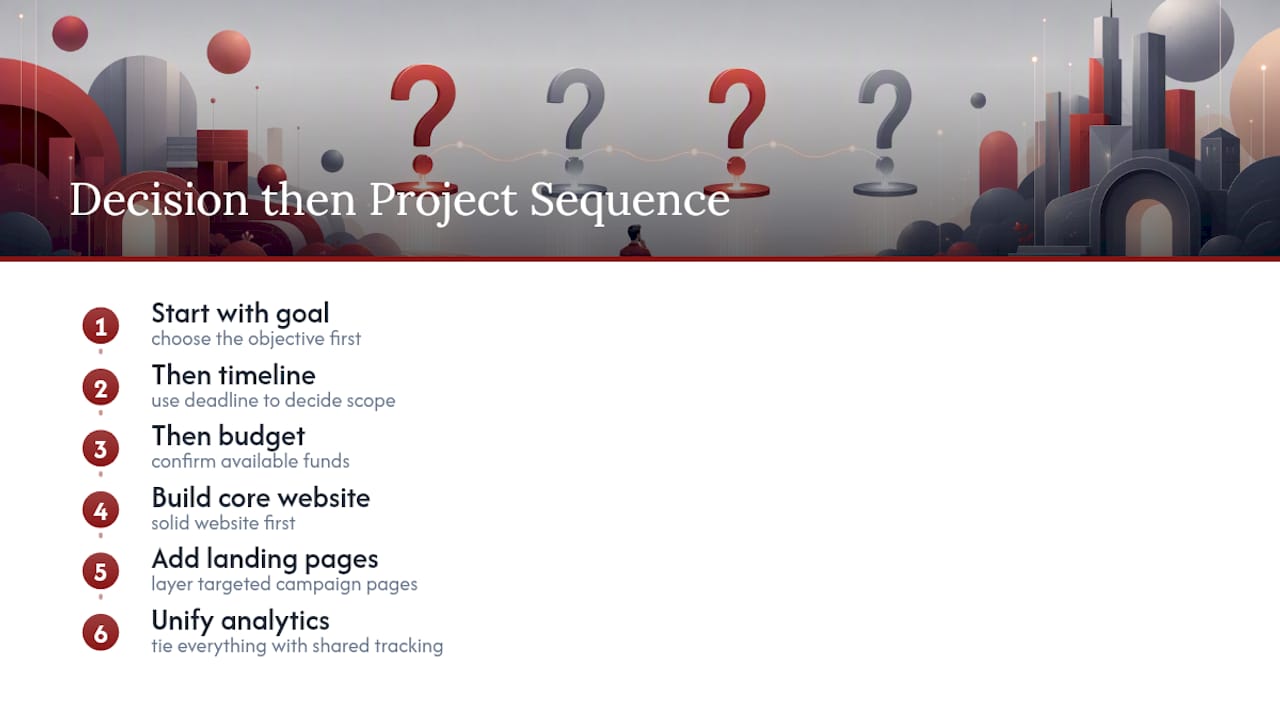
The decision rubric doesn’t start with design. It starts with the goal, then the timeline, then the budget, in that order. A client running a two-week promotion doesn’t need a new website section; they need a landing page live by Friday with tracking already built in.
Dot Xero typically sequences projects the same way most businesses should think about it: a solid core website first, then targeted landing pages layered on for specific campaigns, all tied together with shared analytics. Clients juggling multiple ad platforms, or those who’ve watched a homepage underperform against a real campaign page, are usually the ones who benefit most from bringing in outside help rather than piecing it together solo.
— Will
Get a Site or Landing Page Built by People Who Do This Daily
There are alternatives to guessing your way through a DIY build. Instead of hoping a template site converts or a rushed landing page tracks correctly, you get a page built around your actual goal, with tracking and testing set up from day one, not bolted on afterward.
Whether you need a full website built from the ground up or a focused landing page tied to a specific Google Ads campaign, the process starts the same way: figure out the goal, then build the right asset for it. Dot Xero also handles the traffic side, from email campaigns that feed your landing pages to social ads pointed at the right offer, so nothing ends up disconnected. If your current site isn’t converting the traffic you’re already paying for, that’s usually a structural problem, not a copy problem, and it’s worth a conversation before you spend another dollar on ads. Reach out through Dot Xero’s website development page to talk through what your business actually needs first.
Sources
A few sources back up the core distinctions covered here, if you want to go deeper:
- Landing page vs website: which one does your business need? | AWeber
- What Is a Landing Page? All Your Questions, Answered | HubSpot
FAQ
Do I Need a Website If I Have a Landing Page?
Eventually, yes. Landing pages convert campaign traffic well, but they don’t build the organic search presence or brand trust that a full website provides over time.
Can a Landing Page Be a Website?
Not really. A landing page is a single page with no navigation and one CTA, while a website is a connected group of five or more pages built for exploration, though a microsite can sit in between for campaigns needing a few pages.
Are Landing Pages Still Relevant?
Yes. Landing pages remain one of the most effective tools for converting paid ad and email traffic because they eliminate distractions and let you measure and test one specific action.
How Do I Create a Landing Page?
Define your conversion goal, match the page’s message to your ad or email, build around a single CTA with a short form, and set up UTM and conversion tracking before launch. Agencies can handle this full build, including the tracking setup, for businesses that want it done right the first time.