
Fix Landing Pages First for SMBs: Improve Quality Score in 2–4 Weeks
Landing page experience is the single biggest lever for raising a weak Quality Score, and it’s usually the fastest to move. Fix a “Below Average” landing page before touching bids or ad copy, since one-page change can lift dozens of keywords at once. Once landing page, expected CTR, and ad relevance climb from Below Average toward Average or Above Average, you’ll typically see lower CPCs and better ad positions within 2 to 4 weeks of consistent changes.
TL;DR:
- Fix landing page experience first, as a single page update can improve scores across multiple keywords within a few weeks.
- Improving expected click-through rate requires enhancing ad copy, including keyword placement and adding assets like sitelinks and callouts, not simply increasing bids.
- Focus on matching landing page headlines and offers to ad messages, optimize page speed and mobile rendering, and add trust signals to rapidly boost landing page quality.
- Restructuring campaigns alone rarely improves Quality Score unless accompanied by new copy or destination page updates; changes should follow a deliberate sequence.
- Regularly review historical component data and avoid reacting to daily fluctuations to maintain steady improvements and prevent unnecessary testing confusion.
Table of Contents
- What Quality Score Measures (and Why It’s Not a KPI)
- What Should You Fix First to Improve Quality Score?
- How to Increase Expected CTR With Ad Copy and Assets
- Which Landing Page Changes Improve Quality Score Most?
- Improve Ad Relevance Without Restructuring Everything
- How to Diagnose Quality Score Problems in Your Account
- The Dot Xero Perspective on Fixing Quality Score
- Common Pitfalls That Keep Quality Score Low
- How Quality Score Affects CPC and Ad Auction Outcomes
- How to Keep Quality Score High Over Time
- What Do Successful Quality Score Fixes Actually Look Like?
- What the Data Actually Tells You About Priorities
- Get a Prioritized Quality Score Audit From Dot Xero
- Sources
- FAQ
What Quality Score Measures (and Why It’s Not a KPI)
Quality Score is a 1 to 10 estimate Google Ads assigns to each keyword, built from three components: expected click-through rate, ad relevance, and landing page experience. Each component gets its own status label, and that label matters more than the composite number.
- Above average: this part of your account is performing better than competitors bidding on similar keywords.
- Average: on par with typical performance for that keyword and audience.
- Below average: dragging your score down and worth immediate attention.
Here’s what trips people up: Quality Score itself isn’t a direct input into the auction. Google uses more granular, real-time quality signals to determine ad rank and pricing. The 1 to 10 score you see in your account is a diagnostic snapshot, a way to spot weak points before they cost you money. Treat it like a filter, not a target to chase for its own sake.
What Should You Fix First to Improve Quality Score?
Work in this order, because each stage compounds on the one before it.
- Landing page experience. A single page redesign or content rewrite can touch every keyword pointing to it, which is why this comes first.
- Expected CTR. Once the destination is solid, sharpen the ad copy and assets that earn the click.
- Ad relevance. Tighten keyword groupings and message match last, after the ad and page are already working.
Google’s own guidance echoes this sequence, recommending that advertisers review each Quality Score component individually rather than chasing the blended number. Give each change roughly two to four weeks and a few hundred impressions before judging results. Quality Score components refresh on a rolling basis, not instantly, so checking daily just creates noise.
Pro Tip: Don’t run landing page and ad copy tests at the same time on the same ad group. If both move, you won’t know which fix actually drove the improvement.
How to Increase Expected CTR With Ad Copy and Assets
Expected CTR reflects how likely someone is to click your ad compared to competitors targeting the same search, and it responds directly to how the ad is written and built.
- Front-load your primary keyword in at least one headline, and work that keyword (or a close variant) into 2 to 3 different responsive search ad headlines.
- Write multiple genuinely different headlines per RSA, not just versions of the same sentence. Pin your strongest value proposition to headline position 1 and leave the rest unpinned so Google can test combinations.
- Add every relevant ad asset: sitelinks, callouts, structured snippets, and images. Google’s own testing shows that combining keyword-rich headlines with a full set of ad assets improves expected CTR more reliably than copy changes alone.
- Make the call to action specific: “Get a Free Quote Today” beats “Learn More” for most commercial searches.
- Give a new RSA at least a few hundred impressions before judging it. Pause keywords only after repeated underperformance across multiple ad variations, not after one slow week.
One caution worth flagging: bidding higher does not raise expected CTR. Google normalizes this metric for ad position, so outbidding your way to the top won’t fix a weak score. Only better copy and assets move that needle.
Which Landing Page Changes Improve Quality Score Most?
The fastest wins usually come from matching the page to the ad, not redesigning the whole site.
- Make sure the landing page headline and offer mirror the ad that sent the click. A generic homepage almost always underperforms a dedicated, keyword-aligned page.
- Check Core Web Vitals in PageSpeed Insights: aim for Largest Contentful Paint under 2.5 seconds, Interaction to Next Paint under 200 milliseconds, and Cumulative Layout Shift under 0.1.
- Confirm the page renders cleanly on mobile, since most Google Ads traffic arrives on a phone and a broken mobile layout tanks landing page status fast.
- Add visible trust signals: reviews, licensing or certification badges, clear contact information, and a phone number that’s actually clickable.
- Write enough real content to answer the searcher’s question. Thin pages with just a form and a stock photo rarely earn an Above Average rating.
Pro Tip: Watch conversion rate as a practical proxy while you wait for the landing page status to refresh. If conversions climb after a page change, the experience is probably improving even before Google updates the label.
If your current site can’t hit those speed or mobile benchmarks without a rebuild, that’s usually a sign the page itself needs replacing rather than patching.
Improve Ad Relevance Without Restructuring Everything
Ad relevance measures how closely your ad text matches the intent behind a search, and it’s often misunderstood as a structural problem when it’s really a copy problem.
- Build ad groups around 5 to 15 tightly related keywords that share the same searcher intent, then write responsive search ad copy that speaks directly to that intent.
- Resist the urge to constantly reorganize campaigns. Moving a keyword to a new ad group or campaign doesn’t change Quality Score by itself unless the ad or landing page the user actually sees changes too.
- Spot ad relevance problems by scanning for ad groups where broad, generic copy is trying to cover keywords with meaningfully different intent, a classic sign the group needs splitting.
- Use the component status column to confirm where the weakness actually sits before you touch structure at all.
Restructuring feels productive, but it only pays off when it’s paired with new copy or a new destination page. Otherwise you’re just relabeling the same problem.
How to Diagnose Quality Score Problems in Your Account
Add these columns to your keyword view before making any changes: Quality Score, Exp. CTR (hist.), Ad Relevance (hist.), and Landing Page Experience (hist.). The historical versions show you the trend, not just today’s snapshot.
- Segment by landing page first. If five different keywords all point to the same underperforming URL, you’ve found a systemic issue worth one fix instead of five.
- Segment by ad group and campaign next to see whether the problem clusters in one theme or spreads across the account.
- Set a testing threshold. Wait for a few hundred impressions per keyword or ad variant before drawing conclusions, and give components 2 to 4 weeks to refresh after a change.
- Decide on rollout. If a landing page fix improves scores across a cluster of keywords, roll the same page pattern out account-wide. If results are mixed, keep testing on a smaller set before committing further budget.
A dash instead of a score usually just means there isn’t enough exact-match search volume yet to calculate one, not that something is broken.
The Dot Xero Perspective on Fixing Quality Score
The priority order above reflects what actually moves accounts, not just what sounds tidy in a blog post. Every DIY step here is genuinely implementable by a business owner with a few hours a week. Where an agency earns its keep is speed: running the landing page audit, the RSA tests, and the segmentation work in parallel instead of one at a time.
Common Pitfalls That Keep Quality Score Low
The most common mistake is chasing the blended 1 to 10 number instead of the three components underneath it. A keyword can sit at 5/10 for entirely different reasons depending on which component is weak, and fixing the wrong one wastes weeks.
A close second: testing too many variables at once. Changing the landing page, the ad copy, and the keyword match type in the same week makes it impossible to know what worked. Give one change room to breathe before layering on the next.
Bidding aggressively to “buy” a better score is another dead end, since expected CTR is normalized for position and won’t respond to higher bids. Some advertisers also over-restructure, splitting ad groups repeatedly without ever-changing the ad or the destination page, which leaves ad relevance exactly where it started.
Generic landing pages cause more damage than most advertisers realize. Sending paid traffic from a specific search to a broad homepage breaks the message match Google is scoring, even when the homepage itself is well designed. Thin content is the flip side of the same problem: a page with a headline, a form, and nothing else rarely earns a strong landing page rating no matter how fast it loads.
Finally, watch for impatience. Checking Quality Score daily and reacting to every fluctuation leads to constant, uncoordinated changes. Components need real traffic and time to stabilize, and reacting too fast usually undoes progress that was already working.
How Quality Score Affects CPC and Ad Auction Outcomes
Quality Score doesn’t plug directly into the auction, but the underlying signals it summarizes, expected CTR, ad relevance, and landing page experience, absolutely do. Google uses more granular, real-time versions of these signals to calculate ad rank, and ad rank determines both your position and what you pay per click.
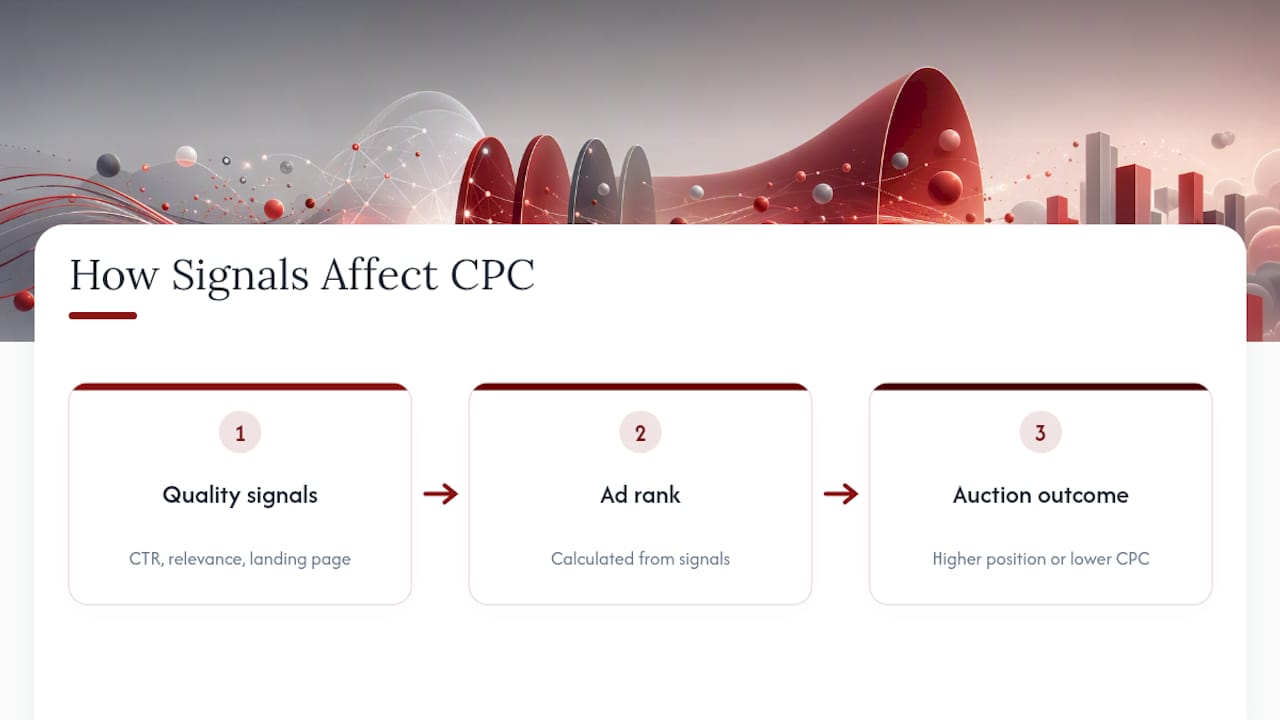
Here’s the practical effect: two advertisers can bid the identical amount and end up paying very different prices. The advertiser with stronger underlying quality signals often pays less for the same position, or ranks higher at the same cost, because Google’s ad rank formula rewards ads that are more likely to satisfy the searcher. This is why agencies and in-house marketers alike watch Quality Score even though it’s not a literal auction input. It’s a readable proxy for the real signals that are.
The compounding effect matters most for accounts running dozens or hundreds of keywords. A landing page fix that lifts ad relevance and expected CTR across twenty keywords doesn’t just improve those twenty rows. It can lower average CPC across an entire campaign, freeing up budget to bid more competitively elsewhere or simply stretch further each month. That’s the real financial case for prioritizing quality over just raising bids: better signals let you win the same auctions for less, rather than outspending competitors to win them anyway.
How to Keep Quality Score High Over Time
Improving Quality Score once is easier than keeping it there, since seasonality, new competitors, and page updates all shift the components without warning.
Build a monthly review into your account management: check the four historical columns (Quality Score, Exp. CTR, Ad Relevance, Landing Page Experience) for any keyword that drops a full status level. Catching a slide from Average to Below Average early is far cheaper than rebuilding from a 3/10.
Refresh RSA headlines on a quarterly cadence even when performance looks stable. Ad fatigue is real: the same headlines that earned Above Average expected CTR six months ago can quietly decay as the same audience sees them repeatedly.
Re-run PageSpeed Insights checks after any site update, theme change, or plugin install. It’s common for a well-optimized landing page to regress after a routine content management system update nobody thought to test against Core Web Vitals.
Pair this with ongoing conversion rate optimization work on your landing pages. Small usability fixes, clearer navigation, faster forms, better mobile spacing, tend to support both conversion rate and landing page experience status at the same time, so the maintenance work does double duty.
What Do Successful Quality Score Fixes Actually Look Like?
The pattern behind most real recoveries is boring, which is exactly why it works: one component gets diagnosed as Below Average, one focused change addresses it, and the advertiser waits the full 2 to 4 weeks before declaring victory or moving to the next fix.
A typical sequence looks like this. An account shows Below Average landing page experience across twelve keywords, all pointing to the same generic service page. The fix is a single dedicated page rebuilt to match the ad’s headline and offer, with load time trimmed and mobile layout corrected. Within a few weeks, landing page experience status improves for most of those twelve keywords simultaneously, because the systemic cause was one page, not twelve separate problems.
A second common pattern involves expected CTR. An ad group running one generic RSA gets rebuilt with 8 to 10 genuinely distinct headlines, the target keyword worked into three of them, and a full set of sitelinks and callouts added. Expected CTR status moves from Below Average to Average as real click data accumulates, and CPC on that ad group typically eases as ad rank improves.
The throughline in both cases: identify the specific weak component, make one meaningful change to address it, and let enough impressions accumulate before judging the result. Businesses that jump between five different fixes in a single week rarely get a clean read on what actually worked.
What the Data Actually Tells You About Priorities
Most advice on Quality Score treats all three components as equally urgent, and that’s the part I’d push back on. Landing page experience deserves priority not because it’s the most “important” component in some abstract sense, but because of leverage: one page fix touches every keyword sending traffic to it, while an ad copy fix only touches one ad group at a time. That’s a practical argument, not a theoretical one.

The overrated fix, in my view, is constant account restructuring. Plenty of advertisers treat a low Quality Score as a signal to reorganize campaigns, when the research is clear that structure alone changes nothing unless the ad or landing page shown to the user changes with it. Restructuring feels like progress. It rarely is, unless it’s paired with new copy or a new destination.
If you take one thing from this guide, let it be sequencing discipline: fix the page, then the ad, then the grouping, and give each stage its own testing window. Skipping around between fixes is the single biggest reason businesses conclude Quality Score work “doesn’t work” when really they never let any one change run long enough to prove itself.
— Will
Get a Prioritized Quality Score Audit From Dot Xero
Running the landing page, ad copy, and diagnostic checklist above takes real hours, and most business owners are already stretched managing the rest of their operation. Dot Xero has managed Google Ads campaigns for Las Vegas businesses since 2007, running the exact priority-first process outlined here: diagnose which component is actually weak, fix the landing page before touching ad copy, and validate results with real impression data instead of guesswork.

If your account has been stuck with Below Average scores for months and you’d rather have someone run the audit and execute the fixes, request a prioritized remediation plan and get a clear read on where your account is losing money to weak Quality Score, and what order to fix it in.
Sources
- About Quality Score for Search campaigns – Google Ads Help
- Three ways to improve your Quality Score — Google Ads
- How campaign structure shapes Google Ads performance – Search Engine Land
FAQ
How Do You Improve Quality Score?
Fix landing page experience first since one page change can affect many keywords at once, then improve expected CTR with better ad copy and assets, then tighten ad relevance. Google recommends reviewing each component separately rather than chasing the overall 1 to 10 number.
What Makes Up a Quality Score?
Quality Score combines three components: expected click-through rate, ad relevance, and landing page experience, each rated Above Average, Average, or Below Average. The full definition and scoring method comes directly from Google Ads Help.
How Do You Calculate Quality Scores?
Google calculates Quality Score using real-time signals behind expected CTR, ad relevance, and landing page experience, then displays it as a 1 to 10 diagnostic estimate at the keyword level. It isn’t a direct auction input, so you can’t reverse-engineer it from CPC alone.
How Do You Improve the Quality Score of Specific Keywords?
Check which component status is Below Average for that keyword using the historical columns, then match the fix to the weak component: rebuild the landing page for relevance issues, rewrite RSA headlines for CTR issues, or tighten the ad group for relevance issues. Give each fix a few hundred impressions and 2 to 4 weeks before judging the result.
Does a Higher Google Ads Budget Improve Quality Score?
No. Expected CTR is normalized for ad position, so bidding higher doesn’t raise Quality Score on its own. Better ad copy, assets, and landing pages are what move the score, regardless of budget size.