
FTC Compliant Google Reviews Strategy for Agencies & Local Businesses
A Google reviews strategy is a repeatable system that asks customers for feedback at the right moment, makes leaving a review effortless, replies to what comes in, and tracks the results over time. The single most useful step you can take today is setting up a timed, post-visit request flow. Just never pay for reviews or pressure customers toward five stars: both practices violate FTC and Google rules.
TL;DR:
- Consistent review requests immediately after positive interactions and using direct links or QR codes are essential for maintaining ongoing review velocity.
- Responding promptly and appropriately to reviews, especially addressing negative feedback offline, helps protect reputation and encourages future customer engagement.
- Compliance requires honest requests from all customers without incentives tied to positive reviews, and clear disclosures are necessary when offering any incentives.
- Tracking key metrics such as review velocity, recency, and response times ensures the review system remains active and effective over time.
- Automating repetitive tasks like sending requests and routing reviews is helpful, but final replies should always be human-edited to avoid insincerity or privacy risks.
Table of Contents
- The four layers of a working review system
- When and how to ask for reviews across every channel
- How to reply to reviews without making things worse
- Staying compliant with FTC and Google rules
- Turning review activity into a measurable program
- Automating review requests without losing the human touch
- How we operationalize review programs for clients
- Getting review strategy support from Dot Xero
- Where to check the official rules yourself
- Sources
- FAQ
The four layers of a working review system
Most businesses treat reviews as something that happens to them. A functioning strategy treats reviews as four connected layers: ask, enable, reply, measure. Skip one and the other three lose most of their value.
Ask means requesting feedback at a specific, repeatable moment, not randomly when someone remembers. Enable means removing friction: a link, a QR code, a one-tap form. Reply means responding to what comes in, publicly and quickly, whether the review is glowing or brutal. Measure means tracking whether the system is producing results month over month, not just hoping it is.
Each layer has its own signal of success:
- Ask: request-to-review conversion rate, the share of people who actually leave feedback after being asked.
- Enable: time from request to submission, which should be minutes, not days.
- Reply: response rate and average response time across all star ratings, not just the positive ones.
- Measure: review velocity and recency, which show whether the flow is still running or has quietly stalled.
Velocity and recency function as ongoing proof of activity. Google’s own guidance states that more reviews and positive ratings can help a business’s local ranking, which means a steady drip of new reviews carries more weight than a burst followed by silence.
Consider two businesses with identical average ratings of 4.6 stars. One collected all its reviews eighteen months ago and has been quiet since. The other adds three to five new reviews every week. The second business shows up as active, current, and trustworthy to both Google’s ranking systems and to a person scrolling reviews on their phone. The framework is not about generating a wall of five-star ratings once. It is about keeping the ask, enable, reply, and measure loop running continuously so the profile never goes stale.
When and how to ask for reviews across every channel
Timing beats almost everything else. Ask immediately after a positive service interaction, while satisfaction is fresh, for transactional businesses like restaurants, salons, or auto repair. For longer engagements such as legal services, home renovation, or consulting, a delayed ask two to five days after project completion tends to produce a more thoughtful, detailed review.
- In person: Train staff to ask verbally at the moment of a compliment, then follow with a text or printed card containing the link.
- SMS: Send within a few hours of service: “Thanks for choosing us today. Mind leaving a quick review? [link]” Keep it under 160 characters.
- Email: Send one to three days later with a subject line naming the service, a single clear button, and no more than two sentences of context.
- QR code on receipts: Point it directly at your Google review form so there is no search step between the customer and the page.
- Landing page flows: Route the QR code or link to a page that opens the review form directly rather than your general Google Business Profile, cutting drop-off.
Google recommends sharing a direct link or QR code and notes that responsive, helpful profiles tend to stand out. Get consent before texting, always include an opt-out, and never ask only customers you suspect had a good experience while skipping unhappy ones: that selective pattern is exactly what regulators flag as manipulation, not marketing.
Pro Tip: Ask every customer the same way, every time. Consistency protects you legally and produces a rating that reflects your actual service, not a curated version of it.
How to reply to reviews without making things worse
Every reply decision runs through three filters: what type of review is this, what’s the goal of responding, and how much risk does this reply carry. A five-star review calls for gratitude and reinforcement. A three-star review calls for clarification and a path to resolution. A one or two-star review calls for damage control that reads as genuine, not defensive.
- Five-star reviews: Thank the customer by name, reference something specific they mentioned, and keep it to two or three sentences.
- Three-star reviews: Acknowledge the specific gap they described, avoid generic apologies, and invite a direct conversation offline.
- One or two-star reviews: Apologize for the specific experience, avoid admitting fault you cannot verify, and move the conversation to phone or email fast.
A sample three-star reply: “Thanks for the honest feedback, [name]. It sounds like the wait time on your visit fell short of what we aim for. We’d like to make it right, please reach out to [contact] so we can sort this out directly.”
Speed matters as much as wording. Aim to reply promptly for negative reviews and within a few days for positive ones. When a review contains false claims, harassment, or clearly violates Google’s Fake Engagement policy, flag it for removal rather than arguing publicly, and escalate internally if a reviewer threatens legal action or names an employee directly. Reserve public back-and-forth for facts you can prove; take everything else to a phone call.
Pro Tip: Never copy-paste the same reply text across multiple reviews. Google and customers both notice repeated boilerplate, and it reads as insincere.
Staying compliant with FTC and Google rules
The FTC’s final rule, announced August 14, 2024, bans buying or selling fake reviews and strengthens enforcement against deceptive testimonial practices. The FTC’s own Q&A clarifies that generalized solicitations, asking all customers for honest feedback without steering sentiment, remain permissible; the risk comes from incentivizing only positive reviews or hiding a financial relationship.
- Do ask every customer, not just the happy ones.
- Do disclose clearly if any incentive is offered for feedback, regardless of sentiment.
- Don’t offer discounts, gift cards, or perks tied to a five-star rating specifically.
- Don’t ask employees or family members to post reviews of the business.
- Don’t suppress or selectively delete negative feedback through unofficial channels.
Google’s Fake Engagement policy carries its own separate consequences: profiles that violate it can face temporary restrictions on receiving new reviews, as Google explains, with an appeals process available if you believe the restriction was applied in error.
Turning review activity into a measurable program
A review strategy without measurement is a guess dressed up as a plan. Track the same core numbers every month: total review count, average rating, days since the last review, review velocity, average response time, and the recurring themes in what customers actually say.
| Metric | What it tells you | Target cadence |
|---|---|---|
| Review velocity | New reviews per month | Weekly check, monthly report |
| Recency | Days since last review | Reviewed weekly |
| Response time | Hours to first reply | Reviewed daily |
| Sentiment themes | Recurring praise or complaints | Reviewed monthly |
Google states plainly that local ranking depends on relevance, distance, and prominence, and that more reviews with positive ratings can improve prominence. A single-location business should aim for steady weekly velocity rather than sporadic spikes. Multi-location operators need the same metrics tracked per branch, since one underperforming location can drag down brand-wide sentiment data without anyone noticing until a report surfaces it.
Automating review requests without losing the human touch
Automation should handle the repetitive parts of the system: sending the request at the right moment, reminding customers who haven’t responded, and routing incoming reviews to the right person for reply. What automation should never touch is generating the review content itself or writing a reply with no human check.
- Use booking or POS triggers to fire review requests automatically after a completed service.
- Route negative reviews to a manager for same-day review rather than a generic queue.
- Draft AI-assisted replies for volume, then require a human edit before publishing, since industry guidance warns that unedited AI drafts risk privacy leaks or promises the business can’t keep.
- Give multi-location teams shared reply templates and clear permissions so brand voice stays consistent across every location.
The workflow that scales best is draft, edit, publish, never draft and publish. A person who knows the specific customer and situation should read every reply before it goes live, even when the first draft came from software.
How we operationalize review programs for clients
Running a review program well means connecting it to the rest of a business’s marketing, not treating it as an isolated task. Review requests can be mapped into email and SMS sequences, review content embedded into location and service pages, and paired with local SEO work so the review activity and the search visibility move together. Governance matters just as much: documented reply playbooks, clear escalation paths for negative feedback, and monthly reporting that shows velocity and sentiment trends, not just a star rating.
— Will
Getting review strategy support from Dot Xero
Building the ask, enable, reply, measure system yourself takes ongoing attention most business owners don’t have time for between running the actual business. Dot Xero builds this into the marketing work we already do for Las Vegas businesses: local SEO that ties review signals to search visibility, email marketing sequences that automate the timed ask, and website work that gets your best reviews visible where new customers actually look.

A discovery call typically starts with a look at your current review velocity, response history, and where the biggest gaps are, then a plan for closing them without generic packages or guesswork. If you want a custom strategy for your specific industry and local market, rather than a template built for someone else’s business, start with our SEO services and we’ll walk you through what a real plan looks like for your business.
Where to check the official rules yourself
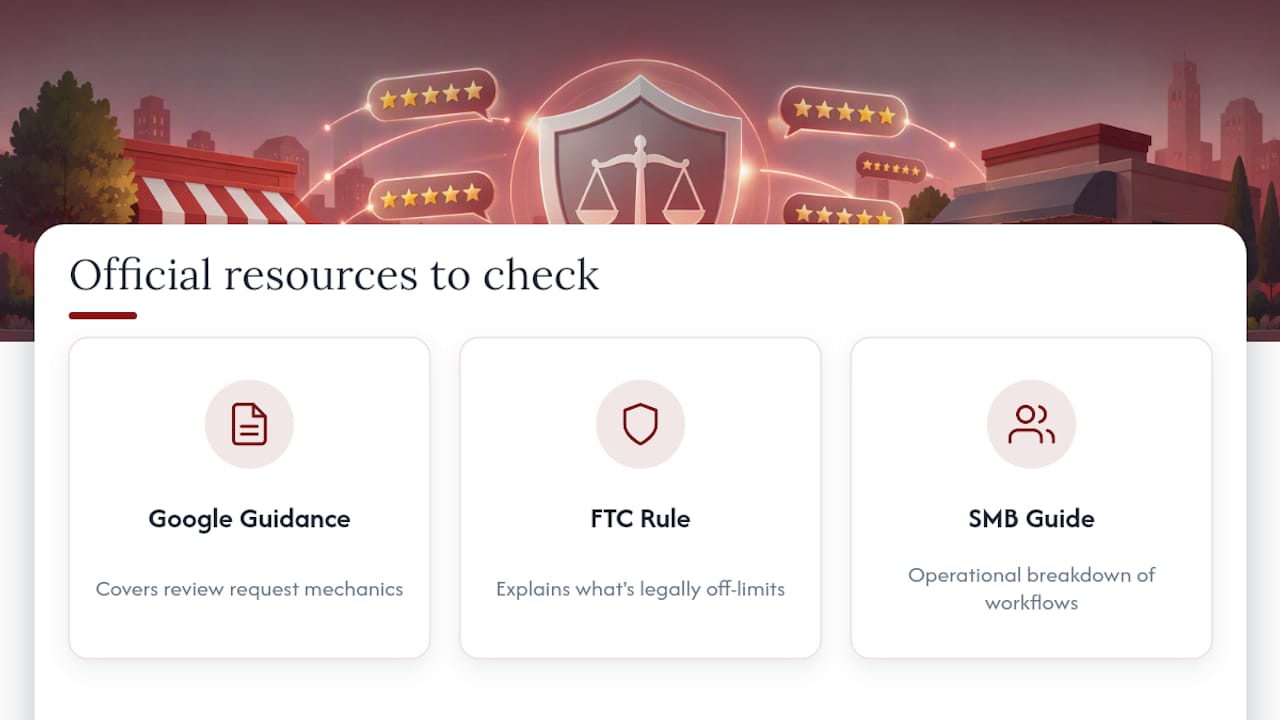
For the policy details themselves, go straight to the source: Google’s review request guidance covers the request mechanics, and the FTC’s rule announcement covers what’s legally off-limits. For a deeper operational breakdown of reputation workflows, this SMB reputation guide is worth a read.
Sources
- Federal Trade Commission Announces Final Rule Banning Fake Reviews and Testimonials
- Tips to improve your local ranking on Google – Google Business Profile Help
FAQ
What is Google’s 20% rule for reviews?
If you’ve seen this term used, it’s likely an informal industry shorthand rather than a documented Google guideline, so treat it as unverified rather than a rule to build a strategy around.
What is the best way to increase Google reviews?
The most reliable approach is a consistent, timed request sent right after a positive service interaction, paired with a direct link or QR code that removes friction, as Google itself recommends. Asking every customer the same way, rather than only the ones you think are happy, keeps the rating honest and keeps you clear of FTC concerns.
What happens when you hit 100 reviews on Google?
Google doesn’t publish a specific milestone or ranking boost tied to any exact number of reviews. What matters more is steady velocity and recency, since Google’s local ranking guidance ties prominence to having more reviews and positive ratings over time, not to a single review count threshold.
How many 5 star reviews do I need to raise my Google rating?
The number depends entirely on your current average and total review count, since a single new review moves the average less as your total grows. Rather than chasing a specific number, focus on steady, honest review requests to every customer: the rating will reflect the service quality over time.