
Fix Google Ads Landing Pages in 2–4 Weeks and Cut Wasted Spend
A Google Ads landing page has one job: prove in three seconds that it matches the ad the visitor clicked, then get them to one action with zero friction. That means tight message match between headline and ad copy, a single conversion goal above the fold, mobile load times under two seconds, and tracking that fires correctly before you spend another dollar. Fix message match and mobile speed first. Everything else is secondary.
TL;DR:
- Correct message match between ad headlines, offers, and CTA language is critical to prevent visitor doubt and ensure high conversion rates.
- Landing pages should load on mobile under two seconds to significantly reduce bounce rates and improve overall ad performance.
- Keep forms minimal and above the fold with trust signals like reviews or client counts to increase lead qualification and engagement.
- Verify final URLs and tracking templates regularly to avoid URL mismatches or errors that decrease Quality Score and ad visibility.
- Running quick audits on existing landing pages for message consistency and speed can deliver measurable improvements within a few weeks.
Table of Contents
- What Is a Google Ads Landing Page and Why Does It Affect Quality Score?
- How Do You Audit Message Match Between Your Ad and Landing Page?
- What Belongs Above the Fold on a High-Converting Hero?
- How Fast Does a Landing Page Need to Load on Mobile?
- How Should Forms and Trust Signals Be Designed for PPC Traffic?
- How Do You Test and Fix Landing Page URL Errors in Google Ads?
- Which KPIs Actually Tell You a Landing Page Is Working?
- What Templates Can You Copy for a Fast Launch?
- How Dotxero Approaches Landing Page Builds for Clients
- Why Most Wasted Ad Spend Has Nothing to Do With the Ads
- Get a Landing Page Built Around Your Google Ads Campaigns
- Sources
- FAQ
What Is a Google Ads Landing Page and Why Does It Affect Quality Score?
A dedicated Google Ads landing page is a standalone page built to answer one search intent tied to one ad group, not your homepage or a general product listing that tries to serve every visitor at once. It strips out the navigation, drops the unrelated offers, and focuses entirely on the promise made in the ad.
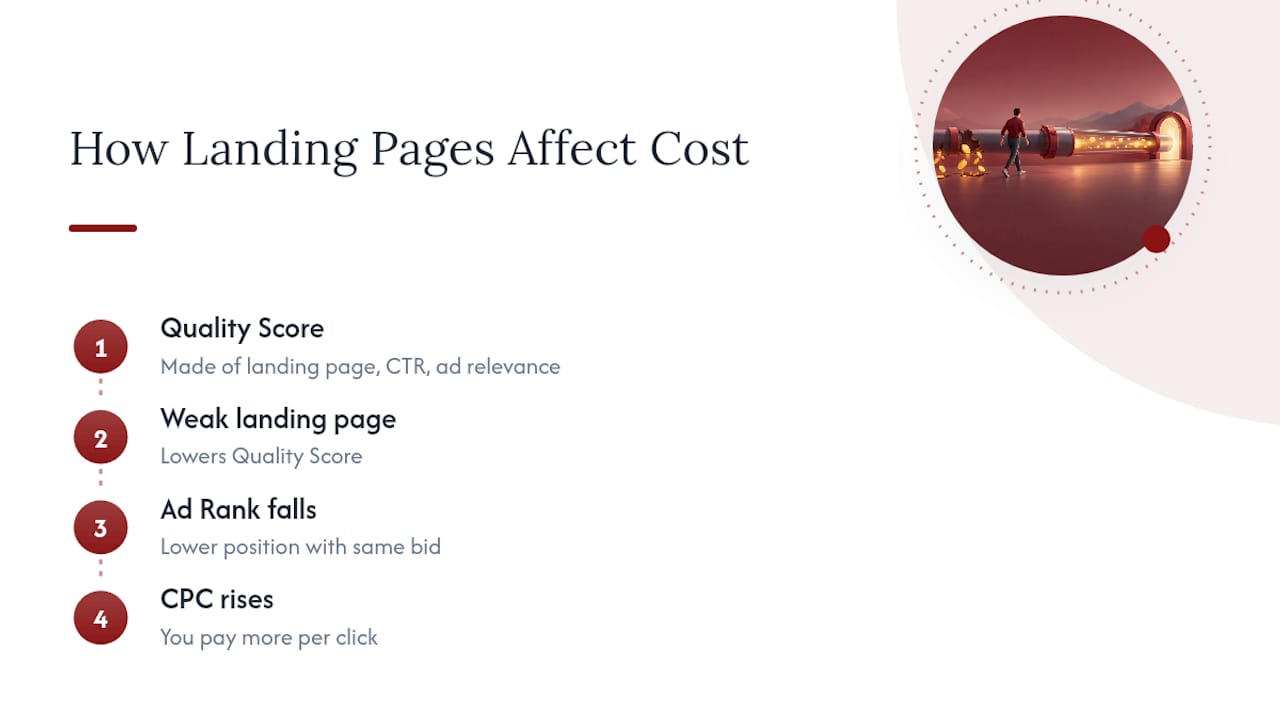
That focus isn’t just a conversion tactic. Landing page experience is one of the three official components of Quality Score, alongside expected clickthrough rate and ad relevance, according to Google Ads Help. A weak score there drags down your Ad Rank, which raises the price you pay per click even when your bid stays the same. Two advertisers can bid identically and pay very different rates because one sends traffic to a page built for the click, and the other sends it to a page built for browsing.
Your homepage or a standard product page can work for branded searches, where the visitor already knows your business and just wants to find you. For everything else, especially cold, intent-driven keywords, a dedicated page built around the exact ad promise is close to mandatory. Sending that traffic to a generic page is the single most common mistake advertisers make, and it’s usually the first thing worth fixing.
How Do You Audit Message Match Between Your Ad and Landing Page?
Message match means the headline, subheadline, offer language, and price or benefit the visitor sees on the landing page mirror what convinced them to click the ad. Break that promise and you lose people before they read a second line, no matter how good the design is below the fold.
Run this audit in under ten minutes:
- Put your ad headline next to your landing page H1. If they don’t share the same core phrase, rewrite the H1.
- Confirm the exact offer (discount, free consultation, price) appears in the same terms on both the ad and the page.
- Check that your CTA button language echoes the ad’s call to action, not a generic “Submit” or “Learn More.”
- Scan for keyword drops. If your ad targets “emergency plumber Las Vegas,” that phrase, or something extremely close to it, needs to appear in your H1 or subheadline.
- Verify pricing or specific numbers mentioned in the ad show up on the page without contradiction.
Small wording mismatches cost more than they should. If your ad says “Free Estimate” and your page says “Request a Quote,” you’ve introduced doubt at the exact moment you needed certainty.
Pro Tip: Copy your top three ad headlines into a spreadsheet next to your landing page H1s. Reading them side by side makes mismatches obvious in a way that scrolling through the live page never does.
What Belongs Above the Fold on a High-Converting Hero?
Visitors decide whether to stay in about three seconds, so everything that matters has to live in the space visible before any scrolling. Five things need to happen there simultaneously: the headline confirms message match, a subheadline states the primary benefit in concrete terms, one trust signal appears (a rating, a client count, a guarantee), the CTA button sits in clear view, and the page itself loads fast enough for any of this to register.
CTA wording matters more than most advertisers assume. “Get My Free Quote” outperforms “Submit” because it states the outcome, not the action. “Book My Consultation” beats “Contact Us” for the same reason. A few patterns worth testing:
- E-commerce: “Shop the Sale” or “Claim 20% Off”
- Lead generation: “Get My Free Estimate” or “Talk to a Specialist”
- Local service: “Call Now for Same-Day Service”
Repeat the CTA at least once more further down the page for anyone who scrolls before deciding, and keep the visual hierarchy pointed at it with color contrast, not clutter.
On imagery, real photos of your team, storefront, or actual product beat generic stock visuals almost every time. A visitor can tell the difference between a licensed stock photo and an actual job site, and the real one builds trust faster even if it’s less polished.
How Fast Does a Landing Page Need to Load on Mobile?
Mobile speed is one of the biggest single levers you have, and the threshold that matters most is Largest Contentful Paint (LCP) under roughly two seconds. Pages that load faster convert measurably better and bounce far less than slower ones, according to Landerlab’s landing page benchmarks. Since most Google Ads traffic arrives on a phone, this is not a nice technical detail. It’s the difference between a visitor seeing your offer and a visitor bouncing before it renders.
Get there with these fixes, in rough priority order:
- Convert images to WebP and compress every asset before upload.
- Defer or remove noncritical JavaScript, especially chat widgets and tracking pixels that load before the fold.
- Strip heavy tag manager containers down to only what you actually use.
- Serve static assets through a content delivery network.
- Tune server response time. A slow host undoes every front-end fix you make.
Test with Google’s PageSpeed Insights and the Mobile-Friendly Test before launch, and rerun both after every major page change. AMP can help in specific high-volume, content-heavy cases, but for most PPC landing pages a well-optimized standard page beats the added complexity of maintaining an AMP version.
How Should Forms and Trust Signals Be Designed for PPC Traffic?
Paid traffic is colder than organic or referral traffic, so every extra form field costs you conversions that pure design polish can’t win back. Ask for the minimum information you need to qualify a lead: name, phone or email, and one qualifying question. Save deeper questions, like budget range or project timeline, for a follow-up call or a second-step progressive form rather than the initial capture.
Trust signals belong above the fold, formatted small and specific:
- A star rating with a review count (“4.9 stars, 200+ reviews”) reads as more credible than a vague claim.
- A client or project count (“Serving 1,000+ Las Vegas homeowners”) gives scale without sounding boastful.
- Security badges matter specifically at the point of payment or sensitive data entry, not scattered throughout the page.
On mobile, add click-to-call buttons for any service business, since a phone call converts faster than a form for urgent needs. Keep tap targets large enough for a thumb, and enable autofill on every field. HubSpot’s guidance on PPC landing page structure backs short forms and above-the-fold social proof as consistent conversion drivers across industries.
Pro Tip: If your service is urgent, like plumbing or locksmith work, put the phone number in the hero, not just the footer. Mobile visitors searching “near me” terms often want to call immediately, not fill out a form.
How Do You Test and Fix Landing Page URL Errors in Google Ads?
Final URL and tracking template are two different things, and confusing them breaks campaigns more often than advertisers realize. The final URL is the actual page the visitor lands on. The tracking template wraps that URL with extra parameters for analytics, and the domain in your tracking template has to match the domain in your final URL or Google Ads will flag the ad.
Google’s built-in landing page test tool catches three common failures before they cost you spend:
- “Landing page has additional parameters” means your tracking template appends query strings the page doesn’t expect. Fix it by confirming the receiving page can parse those parameters, or remove the unnecessary ones.
- “URL mismatch” flags a domain difference between your display URL and final URL. Fix it by aligning both to the same root domain.
- “Page not found” usually means a redirect chain broke or the page was taken down without updating the ad. Fix it by testing the live link manually, not just trusting the campaign dashboard.
Run these tests at the campaign, ad, and keyword level, since tracking templates can be set at any of those tiers and override each other unpredictably. Check your robots.txt file too. It’s a quiet killer: if it blocks Googlebot from crawling your landing page, your Quality Score suffers even though the page works fine for human visitors.
Which KPIs Actually Tell You a Landing Page Is Working?
Watch conversion rate first, but read it alongside cost per acquisition and the landing page experience column inside Google Ads, which flags pages as “below average,” “average,” or “above average” relative to other advertisers targeting the same audience. Google Ads’ own evaluation guidance treats that column as a direct signal for where Quality Score is leaking, and pairing it with GA4 event tracking shows you exactly where visitors drop off on the page itself.
Conversion benchmarks vary enormously by vertical and traffic source, which is why a flat “good conversion rate” number is close to useless without context. CorePPC’s benchmark data breaks this out by industry:
| Traffic source or vertical | Typical conversion rate range |
|---|---|
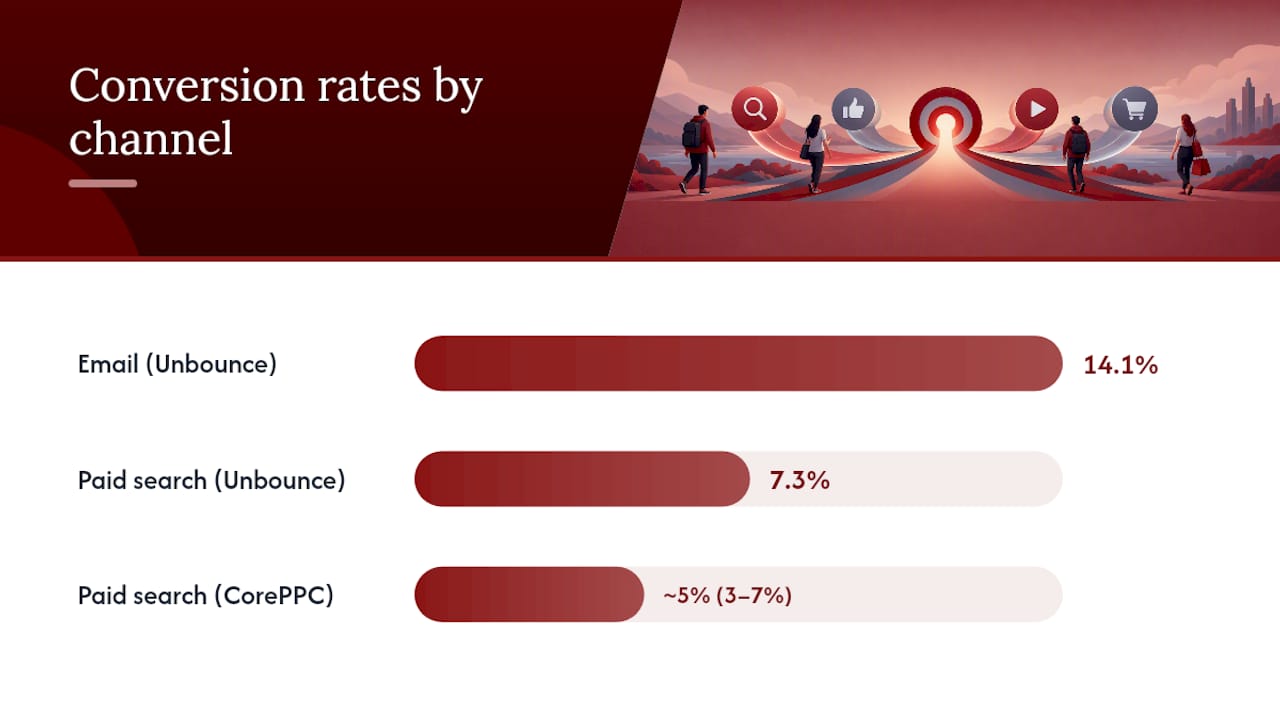
| Paid search, general | Roughly 3% to 7% median across most industries |
| Email traffic | Often well above paid search, sometimes into the low teens |
| Legal and finance lead gen | Frequently lower, given higher-intent but higher-friction offers |
| E-commerce paid search | Varies widely by price point and cart size |
Email traffic converts at a median of about 14.1% versus roughly 7.3% for paid search, according to Unbounce’s benchmark research, which is a useful reminder that a “bad” paid search conversion rate might still be a strong number relative to that channel. If your business also runs email campaigns or social ads, compare each channel to its own benchmark, not to each other.
Once you know where you stand, prioritize tests in this order: headline and message match first, CTA wording second, form length third, and speed or UX refinements last. That sequence consistently produces the largest early lifts before you move into smaller creative experiments.
What Templates Can You Copy for a Fast Launch?
Hero CTA microcopy works best when it names the exact outcome tied to the visitor’s intent:
- Buy intent: “Shop Now and Save 20%”
- Book intent: “Book Your Free Consultation”
- Quote intent: “Get My Free Quote in 24 Hours”
- Sign-up intent: “Start My Free Trial”
For lead generation forms, order fields as name, phone or email, then one qualifying question, in that sequence, since asking for contact details before qualifying questions reduces early abandonment. For e-commerce, keep checkout fields to shipping address, payment, and confirmation, with account creation offered as optional rather than required.
Before you turn traffic back on, run this launch checklist:
- Confirm message match between the live ad headline and the page H1.
- Run a mobile speed test and confirm LCP is under roughly two seconds.
- Fire a test conversion to confirm tracking actually records it.
- Click the ad itself from an incognito window to smoke-test the real link, not just the preview.
How Dotxero Approaches Landing Page Builds for Clients
Dotxero runs the same sequence for every Google Ads client: audit the existing page against message match and speed benchmarks, fix the quick wins first, then build or rebuild the page around a single conversion goal before testing begins. That order matters because it stops budget from bleeding out on ads pointing at a page that was never going to convert.
Since 2007, similar marketing workflows have been applied across various industries where different offer structures and trust signals are needed to close. If your team already has design and development resources, running the message match and speed audits above in-house is entirely realistic. If you’re managing ad spend without the bandwidth to also rebuild landing pages, that’s usually the point where handing the work to an agency starts to pay for itself.
Why Most Wasted Ad Spend Has Nothing to Do With the Ads
The budget waste I see most often isn’t bad targeting or weak ad copy. It’s advertisers running flawless campaigns into landing pages that never matched the ad, phones that took six seconds to load a hero image, and conversion tracking nobody verified after a site migration. Fix those three and you’ve usually solved more than any bid strategy change would.
Expect measurable lifts within two to four weeks of a focused landing page fix, roughly the time needed to gather enough traffic for the change to show up clearly in your data. And resist judging success by conversion rate alone.
— Will
Get a Landing Page Built Around Your Google Ads Campaigns
Most agencies sell landing pages as a design add-on. Dotxero builds them as the second half of a Google Ads campaign, because a page that ignores message match and mobile speed wastes every dollar spent getting someone to click the ad in the first place. A typical engagement starts with an audit of your current page against the checks covered above, moves into quick fixes on message match and load speed, then into a full rebuild if the page structure itself is working against you.
Clients typically see three measurable shifts: a tighter cost per acquisition as Quality Score improves, a measurable conversion lift from removing navigation and matching headline copy, and cleaner reporting once tracking templates are verified at the campaign and keyword level. If your current landing page hasn’t been audited against your live ads in the past few months, that’s the first thing worth checking. Get started with Dotxero’s Google Ads management service and have your existing page reviewed before your next budget cycle.
Sources
- Optimize your ads and landing pages – Google Ads Help
- Google Ads Landing Page: Examples, Benchmarks, and a Diagnostic Tool (2026)
FAQ
What Is the Ideal Load Time for a Google Ads Landing Page?
Aim for a mobile Largest Contentful Paint under roughly two seconds, since pages that load faster convert measurably better and lose fewer visitors to bounce, according to Landerlab’s benchmark research. Test this with Google’s PageSpeed Insights before and after every major page change.
Can I Send Google Ads Traffic to My Homepage?
Only for branded searches where the visitor already knows your business by name. For everything else, a dedicated page built around the specific ad promise consistently outperforms a general homepage, according to Unbounce’s PPC landing page research.
What Is a Good Conversion Rate for a Google Ads Landing Page?
It depends heavily on your industry and traffic source, but paid search traffic often converts in the 3% to 7% range while email traffic can reach around 14.1%, according to Unbounce’s benchmark data. Your own historical breakeven cost per acquisition is usually a better target than any single industry average.
Does Landing Page Quality Really Affect My Cost Per Click?
Yes. Landing page experience is a direct component of Quality Score, and a weak score raises the price you pay per click even at the same bid, per Google Ads Help. Fixing message match and speed is often the fastest way to lower cost per acquisition without touching your bids.
Should I Build My Own Landing Pages or Hire an Agency?
If you have in-house design and development capacity, running the message match and speed audits yourself is realistic. If you’re stretched managing ad spend alone, agencies like Dotxero handle the audit, build, and ongoing testing as part of a managed campaign.