
Practice Area Budget Math: Tracking First Google Ads for Law Firms
Google Ads works for law firms when campaigns are built around three things: practice-area economics that support the click price, tight keyword and match-type discipline backed by deep negative lists, and offline conversion tracking that reports signed cases back to Google, not just form fills. Skip any one of those and you’re funding your competitor’s marketing budget. Expect high costs per click in several practice areas, so plan spend and measurement around case value from day one.
TL;DR:
- Campaigns should be practice-area specific with separate geo-targeted campaigns to accurately allocate budgets and optimize for each area’s performance.
- Bidding and budgeting must be based on case value, with target CPA set in advance, and focus should be on campaigns with the lowest cost per signed case.
- Negative keyword lists need continuous refinement through search term reports to prevent wasting spend on irrelevant queries, especially informational searches.
- Ad copy and landing pages must be directly aligned by practice area and city, prioritizing phone calls over form fills and using clear, localized messaging.
- Offline conversion tracking and call attribution are essential to measure true ROI and adjust campaigns toward generating signed cases rather than just leads.
Table of Contents
- Is Google Ads Right for Your Firm’s Practice Areas?
- How Should You Structure Campaigns by Practice Area and Location?
- What Should You Budget and Bid for Legal Keywords?
- How Do You Pick Keywords and Build a Negative List That Sticks?
- What Ad Copy and Landing Pages Convert Legal Clicks?
- How Do You Track Leads All the Way to Signed Cases?
- Local Services Ads or Search Ads: Which Should You Run?
- What Mistakes Cost Law Firms the Most in Google Ads?
- What Makes Dot Xero Qualified to Manage Legal Google Ads?
- What Should You Prioritize in Your First Two Months?
- How Dot Xero Builds Google Ads Campaigns That Sign Cases
- Sources
Is Google Ads Right for Your Firm’s Practice Areas?
Not every practice area pencils out the same way. Personal injury, mass tort, and DUI defense support aggressive Google Ads spend because a single signed case can be worth thousands to tens of thousands of dollars or more. Family law, estate planning, and criminal defense at the misdemeanor level often have lower case values, which means you need a lower cost per click and cost per lead to stay profitable.
The math is simple once you run it. Take your average case value, decide on a target revenue-to-cost ratio (a 5:1 benchmark is a reasonable starting point for most firms), then divide backward through your expected lead-to-signed-case rate to land on an allowable cost per lead and cost per acquisition.
- If your average case is worth $10,000 and you’re targeting a 5:1 return, you have $2,000 to spend on marketing per case.
- If 1 in 8 leads converts to a signed case, your allowable cost per lead is $250.
- Compare that number to real CPCs in your market before committing budget.
Firms testing new practice areas should start with $2,000 to $5,000 a month for lower-competition categories, scaling to $5,000 to $15,000 or more for competitive metros in personal injury. If your allowable CPA is lower than realistic market CPCs, fix your intake and conversion process first, or lean on SEO and referrals while you build case value data.
How Should You Structure Campaigns by Practice Area and Location?
Structure follows economics. Every practice area behaves differently in the auction, converts at a different rate, and needs its own budget ceiling, so mixing them into one campaign muddies your data and starves your best performers of budget.
- Build one campaign per practice area. A firm handling personal injury and family law runs two separate campaigns, not two ad groups inside one. This keeps budgets, bid strategies, and negative lists independent.
- Layer geography inside each campaign. For single-market firms, a simple radius or city target works. For multi-state or multi-office firms, run separate geo-targeted campaigns so you can adjust bids and budgets by market instead of averaging performance across regions that behave nothing alike.
- Choose campaign types deliberately. Standard search campaigns handle high-intent queries. Call-only campaigns work well for mobile searchers who want to talk to someone immediately. Performance Max can work in legal accounts, but only with tight asset controls and placement exclusions, since it will otherwise spend on display and YouTube inventory that rarely produces a signed case.
- Match every ad group to its own landing page. A car accident ad group should land on a car accident page, not a general personal injury page, and definitely not the homepage.
This structure mirrors what works across the industry: separate campaigns per practice area and geography, each pointed at a dedicated landing page built for that exact search.
Pro Tip: Name campaigns with practice area and geo baked into the label (“PI_LasVegas_Search”) so anyone auditing the account in six months can see the structure without opening a single ad group.
What Should You Budget and Bid for Legal Keywords?
Legal clicks are expensive, and they vary wildly by practice area. Personal injury and mass-tort keywords can run $80 to $800 or more per click depending on the market, while family law, estate planning, and lower-competition criminal defense terms are often a fraction of that.
Set your target CPA before you set your bids, not after.
- Start with average case value and your firm’s lead-to-signed-case conversion rate, not an industry guess.
- Build in a buffer for intake friction. Even qualified leads drop off if calls go unanswered or forms sit for a day.
- Set your initial Target CPA or Target ROAS bid slightly above your calculated allowable CPA, then tighten it as data accumulates.
- Allocate budget toward the campaigns with the best cost per signed case, not the ones with the most clicks.
Google’s automated bidding is only as smart as the data you feed it. Smart Bidding needs high-quality conversion signals to work well in legal accounts. If you’re optimizing toward form fills or calls instead of signed cases, Google will happily chase cheap, low-value leads and call it a win. Offline conversion imports fix this, and we’ll get into the mechanics of that shortly.
Budget allocation across markets should follow the same logic as bidding: put money where cost per signed case is lowest, and pull back from campaigns that generate volume without producing clients.
How Do You Pick Keywords and Build a Negative List That Sticks?
High-intent keywords look like someone who needs a lawyer right now: “car accident lawyer [city],” “DUI attorney near me,” “file for divorce lawyer.” Informational queries like “what to do after a car accident” or “how long does probate take” attract researchers, not clients ready to hire, and they’ll drain budget fast if you don’t isolate them into a separate testing campaign with its own low bid cap.
Match-type discipline matters more in legal accounts than almost any other industry because the cost of a wasted click is so high.
- Favor phrase and exact match over broad match for your core money keywords. Broad match can work for discovery in a small testing budget, but running your main practice-area terms on broad match in a $150-per-click category is how firms burn through budget in a week.
- Mine your search terms report weekly for the first two months, then biweekly after that, pulling out every irrelevant query and adding it as a negative.
- Pull negatives from three sources beyond search terms: your firm’s own FAQ page (patients researching, not hiring), competitor law firm names, and job-seeker terms like “paralegal jobs” or “attorney salary.”
- Set up automated rules or scripts that flag spend spikes on individual search terms so you catch a runaway query before it eats a day’s budget.
Deep negative lists, often running into the hundreds or thousands of terms in mature accounts, are one of the clearest markers separating profitable legal PPC accounts from the ones bleeding money.
What Ad Copy and Landing Pages Convert Legal Clicks?
The formula that works across practice areas is simple: name the practice area, name the city, add a trust signal, and close with a direct call to action. “Las Vegas Car Accident Lawyer. Free Consultation. Call Now” outperforms vague, benefit-heavy copy almost every time, because someone searching for a lawyer at 11 p.m. wants confirmation you handle their exact problem in their exact city.
- Enable call extensions on every campaign. Most legal prospects call rather than fill out a form, and a visible phone number in the ad itself removes a step between intent and contact.
- Add location extensions if you have a physical office; it builds trust and supports local relevance.
- Use sitelink extensions to surface specific practice-area pages, not just your homepage.
- Add review extensions or star ratings where eligible. Legal decisions are trust-heavy, and social proof reduces hesitation.
Your landing page needs exactly one job: get the visitor to call. That means the phone number sits above the fold, ideally as a tap-to-call button on mobile, and the page content matches the ad’s exact promise. A page about “personal injury services” performs worse than a page specifically about “motorcycle accident claims” when that’s what the ad promised.
Pro Tip: Test one variable at a time. Run a headline test until you have a statistically meaningful sample, then move to CTA wording, then page layout. Testing three things simultaneously just tells you something changed, not what worked.
Mobile-first, phone-visible landing pages consistently outperform desktop-style pages crammed with text, because most legal searches happen on a phone in a moment of urgency.
How Do You Track Leads All the Way to Signed Cases?
Clicks and form fills tell you almost nothing about whether Google Ads is actually working. Signed cases tell you everything, and getting that data back into Google is the single highest-leverage technical step in the entire campaign.
- Set up offline conversion imports so your CRM’s case-close data flows back into Google Ads, letting the algorithm learn which clicks and keywords actually produce clients rather than just leads.
- Implement call tracking with dynamic number insertion, which swaps in a unique tracked number for each visitor so every call gets attributed to the specific keyword and ad that generated it.
- Since 60% to 80% of legal conversions may come through phone calls, skipping call tracking means your ROI numbers are built on a fraction of the real picture.
| Metric | What it tells you | Review cadence |
|---|---|---|
| Cost per lead | Raw efficiency of ad spend to contact | Weekly |
| Cost per signed case | True profitability signal | Monthly |
| Lead-to-case conversion rate | Intake and sales process health | Monthly |
| Client lifetime value | Whether case value assumptions hold up | Quarterly |
Once offline conversion data has a few weeks to accumulate, use it to shift budget toward the campaigns and keywords producing signed cases at the lowest cost, and pause or restructure anything generating leads that never convert.
Local Services Ads or Search Ads: Which Should You Run?
Local Services Ads charge per lead instead of per click, and they carry the Google Screened badge, which builds instant trust with someone comparing several attorneys in a search results page. Search ads charge per click regardless of whether that click ever calls you, which means a curious clicker costs you money even if they never convert.
- LSAs often produce a lower cost per acquisition for local, single-office practice areas like family law or DUI defense.
- Search ads give you more control over targeting, messaging, and landing-page experience, which matters more for complex or high-value practice areas like mass tort.
- Most firms benefit from running both simultaneously and letting the data decide where to shift budget.
- Compare channels using cost per signed case, not cost per lead. LSAs can look cheaper per lead and still produce worse clients if lead quality is low.
Test both for at least 60 to 90 days with consistent tracking before deciding which one deserves the bigger share of your budget.
What Mistakes Cost Law Firms the Most in Google Ads?
The most expensive mistake is running broad match on high-cost keywords without a negative list to catch the noise. The second most expensive is sending paid traffic to a homepage instead of a matching landing page. The third is running ads for months without call tracking, which means every ROI report is a guess dressed up as a number.
- Never promise case outcomes or specific results in ad copy or landing pages. State bar advertising rules in most jurisdictions prohibit result guarantees, and violations can trigger real disciplinary consequences.
- Avoid disclosing confidential client details in testimonials or case examples without documented consent.
- Review your firm’s state bar advertising rules before publishing any new ad copy, especially language touching on outcomes, comparisons, or specialization claims.
- Confirm intake speed, call scripts, and CRM logging are in place before scaling spend. Fast, expensive leads that sit unanswered for hours are wasted money regardless of how good the campaign is.
- If cost per signed case climbs for two consecutive months with no clear cause, pause the underperforming campaign and audit search terms immediately rather than waiting for a quarterly review.
What Makes Dot Xero Qualified to Manage Legal Google Ads?
Dot Xero has managed digital marketing for Las Vegas businesses, including law firms, since 2007, which means the agency has watched several generations of Google Ads features come and go without losing sight of what actually produces signed cases.
- Full campaign build and management: practice-area segmentation, geo-targeting, ad copy, and extension setup.
- Landing pages built specifically for paid traffic, matched to each practice area and campaign.
- Offline conversion tracking and call-tracking integration so ad spend gets measured against real client outcomes, not vanity metrics.
- Transparent monthly reporting focused on cost per signed case rather than cost per click alone.
(Author bio, client case studies, and relevant certifications to be added.)
What Should You Prioritize in Your First Two Months?
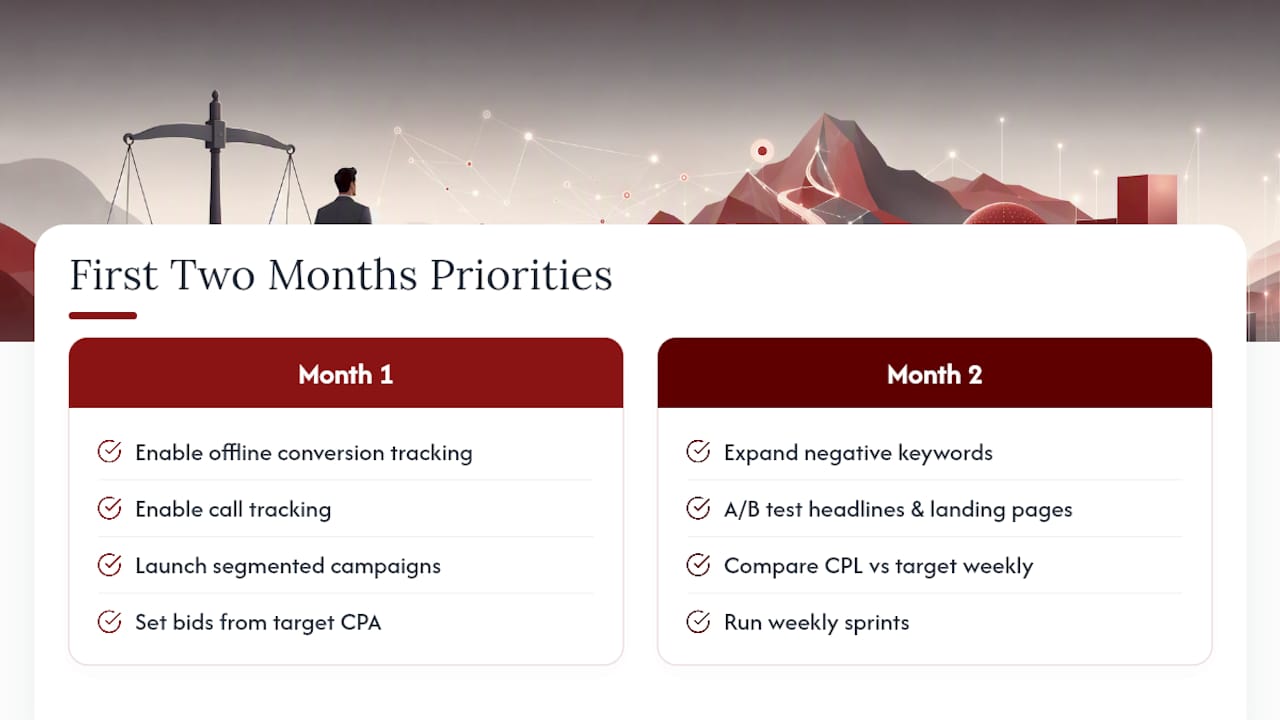
Month one is foundation work: get offline conversion tracking and call tracking live before you spend a dollar on clicks, launch campaigns segmented by practice area and geography, and set initial bids based on your calculated target CPA rather than a guess.
Month two is refinement. Expand your negative keyword list using the first month’s search terms report, test new headlines and landing-page layouts against your original versions, and compare cost per lead against your target CPA weekly. Treat every week as a sprint. Legal accounts reward the firms that adjust fast and punish the ones that let broad match and stale ad copy run unchecked for a full quarter.
— Will
How Dot Xero Builds Google Ads Campaigns That Sign Cases
Everything in this guide, the campaign structure, the negative keyword discipline, the offline conversion setup, is exactly what Dot Xero’s Google Ads management team builds for Las Vegas law firms from the first month of a contract. You get campaigns segmented by practice area and geography, landing pages designed around a single phone-first call to action, and call tracking wired directly into reporting so you see cost per signed case instead of cost per click.

Reporting is built around the same month-1 and month-2 priorities covered above: tracking live before spend starts, negative lists expanding weekly, and budget shifting toward whatever is actually producing clients. If your current campaigns are generating clicks without signed cases, request a Google Ads review and see what a tracking-first rebuild would look like for your practice area.
This article is general information, not a substitute for advice from a qualified lawyer. Consult a qualified legal professional about your own circumstances before acting on anything here.